Friday, November 13, 2009

A Guide to the Heart-The Most Holy Theotokos and Ever Virgin Mary


The Most Holy Theotokos and Ever Virgin Mary, Our Panagia

"Now in the sixth month the angel Gabriel was sent by God to a city of Galilee named Nazareth, to a virgin betrothed to a man whose name was Joseph, of the House of David. The virgin's name was Mary (Mariam in Hebrew). And having come in, the angel said to her, "Rejoice highly favoured one, the Lord is with you, blessed are you among women!" Then the angel said to her, Do not be afraid Mary for you have found favor with God. And behold, you will conceive in your womb and bring forth a Son, and shall call His name Jesus (Yeshua in Hebrew). He will be great and will be called the Son of the Highest; and the Lord God will give Him the Throne of His father David. And He will reign over the House of Jacob forever and of His kingdom there will be no end. Then Mary said to the angel, How can this be since I know no man? And the angel answered and said to her, The Holy Spirit will come upon you. and the Power of the Most High will overshadow you; therefore, also that Holy One who will be born will be called the Son of God". From the Gospel of Luke 1:26-35


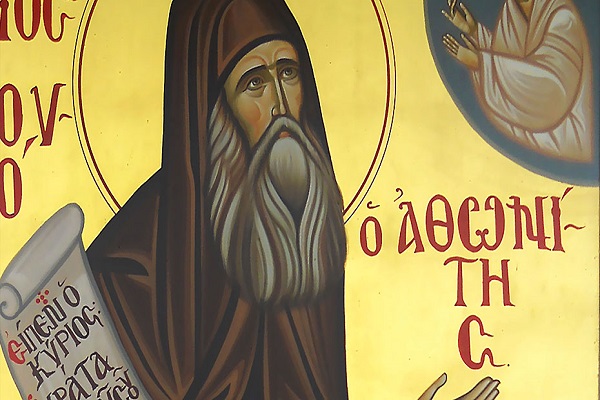
"O holy Virgin Mary, tell us, thy children, of thy love on earth for thy Son and God.
Tell us how thy spirit rejoiced in God thy Saviour.
Tell us of how thou didst look upon His fair countenance,
and reflect that this was He Whom all the heavenly hosts wait upon in awe and love.
Tell us what thy soul felt when thou didst bear the wondrous Babe in thine arms.
Tell us of how thou disdt rear Him,
how sick at heart, thou and Joseph sought Him three long days in Jerusalem.
Tell us of thine agony when the Lord was delivered to be crucified,
and lay dying on the cross.
Tell us what joy was thine over the Resurrection.
Tell us how thy soul languished after the Lord's Ascencion.
We long to know of thy life on earth with the Lord but thou wast not minded to commit all these things in writing, and didst veil thy secret heart, in silence." A hymn by St Silouan the Athonite.


My love for the Theotokos is a new dimension in my life. As a Protestant I did not really understand Her place in Orthodox worship. But when I became Orthodox, when I became a member of the Orthodox 'family' I begun to understand why we love her so much. The place of the Theotokos is a mystery of the Church. And it is a mystery that is only to be known and experienced by the members of our Orthodox family. The saints know this better than anyone else. It is a matter of relationship. She is the the most humble of human beings. So even in Her ministry to us she is a mother, really. Mothers do not sound the trumpet before them while they take care of their children, they just love their children. It is a natural thing. And I know she loves us no matter what. No saint has become a saint without a close relationship with the Theotokos. The self-acting prayer of Jesus in the heart is Her gift. Many saints have received this gift while praying before Her icon.
 Saint Silouan the Athonite tells that;
"Once when I was a young novice I was praying before an icon of the Mother of God, and the Jesus Prayer entered into my heart  and there begun to repeat itself of its own accord". "Here is a wondrous thing which passes understanding: she dwells in heaven and ever beholds the glory of God, yet she does not forget us, poor wretches that we are, and spreads her compassion over the whole earth, over all peoples. And this most pure Mother of His, the Lord has bestowed on us. She is our joy and our expectation. She is our Mother in the spirit, and kin to us by nature, as a human being, and every Christian soul leaps to her in love". From Saint Silouan the Athonite by Archimandrite Sophrony p.391,393.

"If one examines all the feasts of the Orthodox Church carefully one realises that the Church wants to connect our life with Christ. The ecclesial year begins on the 1st of September and finishes at the end of August. At the beginning of September we celebrate the Birth of the Theotokos. It is with the birth of the Most Holy Mother of Christ that the backwards countdown for man's salvation starts. The ecclesial year continues with the Nativity of Christ up to Pentecost, which is the feast of man's deification, and ends up with the glorious Dormition of the Panagia which shows the glory that a man can reach when he is united with Christ. Thus, keeping the analogy, that what happened with Panagia should also happen to us, Christ should be born in our heart". The Feasts of the Lord p.11, by Metropolitan Hierotheos Vlachos, Trans. by Esther Williams, Birth of the Theotokos Monastery 2003.
 According to St Symeon the New Theologian (Ethical Discourse 1) the saints are related to the Theotokos in three ways.
"First they are related because of human nature, since both they and she come from the same clay and the same breath. The Panagia was the Mother of God, but at the same time she was also a human being as we are. Secondly, they are related because it is through the flesh taken from her that they have a part in common with her" When we commune of the sacraments, of the Body and Blood of Christ, we commune of the deified flesh of the Word which He assumed from the Virgin. Therefore as St Symeon teaches, in communing of the Body and Blood of Christ, we commune also of the flesh of the Theotokos.
Thirdly, the saints are related to the Panagia "because through the holiness in spirit which came to them thanks to her, each one conceives and also possesses in himself the God of all, just as she possessed Him within herself". From St Gregory Palamas as a Hagiorite by Metr. Hierotheos Vlachos p.270.

The Most Holy Virgin is our foremost guide to the heart because, as Metropolitan Hierotheos Vlachos tells us ; "When the nous( in St Paul's terminology 'spirit', the nous is the energies of the heart, the spiritual organ by which it has communion with God) withdraws from God and wanders in search of sensory things, it is ill and this in reality is man's illness. The nous needs to be cured first: to be freed from all its slavery to created things, and to be liberated from all the sensations of created things. There must be forgetfullness of things below, laying aside of all concepts, and then initiation into the things above. This is called hesychia of the nous and is also called 'the way of hesychia' and 'holy hesychia'. In attaining health of his soul through holy hesychia a person attains the vision of God, by which he is deified. Using this method we are relieved of lower things and turn towards God. Our Panagia used precisely the same method, according to St Gregory Palamas, and in the holy of holies she attained deification by Grace and became a borderline between uncreated and created". Ibid p.281-282
"She transmits grace to the saints 'in order that as in charge of the office where holiness is given, she may convey gifts of holiness to all without exception, without leaving anyone without a share, even of the hidden things of the universe, that is to say of those inaccessible things" St Gregory Palamas in Homily 53, Ibid. p.295. "and so also in the coming unending age every advance in divine illumination and every revelation of the most divine mysteries and every idea of spiritual gifts is impossible to contain without her. She, having first received the fullness of that which fills the universe, made it containable to all, bestowing on each according to
the ability and measure of his purity. The Panagia is both treasury and office for granting the wealth of the divinity" St Gregory Palamas in Homily 53, Ibid p.296
"She also is a cause of those before her and patron of those after her and a cause of things eternal; she is a promise of the prophets, foundation of the Apostles, support of the martyrs, platform of the teachers, she is the glory of those on earth, the delight of those in heaven, the adornment of all creation; she is also the principle and source and root of the ineffable good things, she is the summit and completion of every saint" St Gregory Palamas in Homily 53, Ibid p.297

We should all long for the day when our purification is complete, when along with all the saints we may join the Theotokos in worship to God saying; "My soul doth magnify the Lord , and my spirit hath rejoiced in God my Saviour. For He hath regarded the low estate of His handmaiden: for, behold, from henceforth all generations shall call me blessed. For He that is mighty hath done to me great things and holy is His name. And His mercy is on them that fear Him from generation to generation". Luke 1: 46-50

Therefore, let us  pray;
"O Virgin Lady, O Mother of the man-befriending God! Direct my heart to contrition and humble it; fill mine eyes with saving tears and illuminate them with the light of thy prayers, that I might not fall asleep in the sleep of death.
Sprinkle me with the hyssop of thy lovingkindness and cleanse me. Wash me with my tears, that I might be made whiter than snow.
O Mother of my Lord Jesus Christ, receive this my shameful confession and mine entreaty. Ravish my mind and keep the remainder of my life in repentance without offence.
At the time when my humble soul departs from my body, when - woe is me - I will have to speak with the enemies outside the gates; then O Lady, regard me with thy merciful eye; free me from all the merciless tormentors and the terrible taskmasters of the prince of this age; be my defender and destroy all record of my sins. Lead me saved and unashamed to the throne of thy Son and His unoriginate Father and the All Holy Spirit- the Light- creating Trinity, one in essence". St Ephraim the Syrian in 'A Spiritual Psalter' p.229
Amen!

Monday, November 2, 2009

Stories That Warmp Up The Heart-A Miracle from St Panteleimon

St Panteleimon, Thessaloniki, Greece

When I pray, I always commend my family to St Panteleimon. Every time I go to Thessaloniki, Greece, I like to go to the Church of St Panteleimon and just sit there and pray alone while the caretaker of the temple does her work. She lets me stay for as long as I want. I have always believed that the saint listens to my prayers. This past winter, St Panteleimon saved the lives of my mother Maria, brother Abnel and sister-in-law Ruth.
They are Protestants and live in the Caribbean island of Puerto Rico. I am the only Orthodox Christian in my family and I live in WA state. On Saturday, December 27, 2008 my mother and siblings were driving back home from my sister Ivette's house. It was close to midnight, when all of a sudden, the river flash-flooded and washed over the road level flushing their car into a very deep precipice. The car rolled over several times ending upside down and totally destroyed. My mother was not wearing her seatbelt. The only thing she did during the accident was to say; "Glory to God" continuously. The car's descent was stopped by a tree and as soon as my brother and his wife were able, they got out of the car. My mother was not able to get out but everyone seemed to be fine.
It took 8 men and heavy equipment to extricate my mother out of the car. They were all sent by ambulance to the hospital but when they were all examined, they were perfectly OK! They did not have a scratch on their bodies, no bleeding, nothing!
Everyone that sees the destroyed car, and the precipice cannot fathom how my family is alive.
My sister tells me that before my family was taken to the hospital, my brother and sister-in-law stayed by the car waiting for help to come. They did not want to move my mother because she could have been hurt if moved inappropiately.
While they were waiting for help, a man came out of nowhere and walked straight to my mother and told her; "God is protecting you, I am here to stay with you until help comes, do not worry, God is with you". This man was not a paramedic. The ambulance was not even at the site yet.
All the man did was hold my mother's hand and comfort her until the ambulance came. To this day, no one knows who this man is. He was not seen again after my mother was placed in the ambulance. And my mother talks a lot about this man, and the feeling she had in her heart while he was with her.

While my sister was talking to me, the name of St Panteleimon was constantly in my mind and for many days all I could think was that the saint saved my family. I have an inner assurance of this that is hard to describe. I know St Panteleimon saved my family. Glory be to God who is glorified in His saints!

Troparion to St Panteleimon
O holy passion-bearer and healer Panteleimon, entreat our merciful God, that He grant our souls remission of transgressions.

Megalynarion
We magnify thee, O holy Passion-bearer, great martyr and healer Panteleimon, and we honor thy precious sufferings, which thou didst endure for Christ.

From the Menaion published by St John of Kronstadt Press, Liberty, TN


Sunday, October 25, 2009

Stories That Warm Up The Heart-On The Heart Ready For God


Martyrdom of St Demetrios of Thessaloniki, the Myrrh-Gusher

The Great Martyr Demetrios of Thessaloniki was in such a state of grace and peace in his soul, that when he saw the soldiers coming to slay him, he raised his right arm, so he would be lanced on his side, like his Lord Jesus Christ. When he was pierced, at once, blood and water flowed from his wounds. The icon above is on the wall inside the shrine of the saint, in the great church of St Demetrios, Thessaloniki, Greece. Also in the church, is the vase that was used to collect the blood of the martyr, with dried up blood still visible inside it!

"ON THE HEART READY FOR GOD
Homily for October 26-St Demetrios the Myrrh-Gusher, Prologue of Ohrid vol 2, p.450 by St Nikolai Velimirovich

My heart is ready O God, my heart is ready (Psalm 57.7)

Brethren, blessed is he who is able to speak like this to his Lord! Blessed is he whose heart is completely ready to follow the will of God. The readiness of the heart of man lies in this: to joyfully follow the will of God and not be confused by one's own thoughts and desires. At first, the repentant King David had followed his own sinful thoughts and desires, and was like a boat on a stormy sea. However, when he realized that the storm was going to drown him, he turned to God with great repentance and tears, and turned the boat of his life entirely over to God. "My heart is ready O God, my heart is ready", he cried out with great peace of soul, for he knew that he had given his boat into the hands of the Most-skilled Helmsman. The storm still raged and the winds and waves still assaulted him, but he was not afraid, convinced that nothing could smash his boat, and that his boat would sail safely to a calm harbor. A 'ready heart' means a heart cleansed of pride and humbled before the majestic power and wisdom of God. A 'ready heart' means a heart emptied of all worldly desires and illusions, and filled with nothing but aspirations toward God and love for God. A 'ready heart' means a heart that is healed of all restlessness, cares and fears, and is quieted and encouraged by the presence of God's grace. "I will sing and give praise in my glory" (Psalm 57:7), continues the Psalmist. This shows that his heart is truly ready - he is not proud of his royal glory but ascribes it to God. He humbled himself before God as nothing, and now his sole pleasure is to magnify and glorify God. His personal glory only gives him a reason for glorifying His All-glorious God.

O my brethren, let us endeavor that our hearts be ready before God: ready to hear the word of God, ready to follow the will of God, ready to glorify the Living God.

O Lord God, our immortal Creator, help us to ready our hearts, that they may be vessels of Thy life-giving grace. To Thee be glory and praise forever. Amen".

"How wonderful is this abundance that the Lord should reside in us continually,
for He has left the heavens and descended:
let us make holy for Him the bridal chamber of our hearts"
Ephraim the Syrian, 'Armenian Homilies' 47,Quoted by Fr Sebastian Brock in 'The Luminous Eye' p.128

Tuesday, October 13, 2009

The Spiritual Hospital - The Orthodox Church


             The Church of St Panteleimon, Thessaloniki, Greece

The Orthodox Church is the spiritual hospital and the Ark of Salvation, the place where our spiritual healing can take place. She alone is the depository of Grace with the power to make us whole. She alone, has remained faithful to the healing, therapeutic science of the Church Fathers. The Orthodox Church is the Body of Christ and remains forever the 'Pillar and Foundation of the Truth',
1Timothy 3:15.
By publishing "The Confession of Faith Against Ecumenism" in this, my humble blog, I declare formally that I agree with this confession and subscribe to it.
David Robles, Orthodox Faithful


A Confession of Faith Against Ecumenism
From the Convention of Orthodox Clergymen and Monks April 2009
Translated from Greek by
WWW.OODEGR.COM


Those of us who by the Grace of God have been raised with the dogmas of piety and who follow in everything the One, Holy, Catholic and Apostolic Church, believe that:
The sole path to salvation of mankind [i] is the faith in the Holy Trinity, the work and the teaching of our Lord Jesus Christ, and their continuance within His Body, the Holy Church. Christ is the only true Light [ii]; there are no other lights to illuminate us, nor any other names that can save us: «Salvation is not within anything else; nor is there any other name under the heavens that has been given to mankind, in which we can be saved» [iii]. All other beliefs, all religions that ignore and do not confess Christ "having come in the flesh" [iv], are human manufacturings and works of the Devil, [v] which do not lead to the true knowledge of God and rebirth through divine Baptism, but instead, mislead men and lead them to perdition. As Christians who believe in the Holy Trinity, we do not have the same God as any other religion, nor with the so-called monotheistic religions, Judaism and Mohammedanism, which do not believe in the Holy Trinity.For two thousand years, the Christ-founded and Holy Spirit-guided Church has remained stable and unshakeable in the salvific Truth that was taught by Christ, delivered by the Holy Apostles and preserved by the Holy Fathers. She did not buckle under the cruel persecutions by the Judeans initially and later by idolaters during the first three centuries; She brought forth a host of martyrs and came out victorious, thus proving Her divine origin. As Saint John the Chrysostom beautifully expressed it: «Nothing is stronger than the Church... if you fight against a man, you either conquer or are conquered; but if you fight against the Church, it is not possible for you to win, for God is the strongest of all» [vi].Following the cessation of the persecutions and the triumph of the Church over Her external enemies - in other words, the Judeans and the idolaters - the internal enemies of the Church began to multiply and strengthen. A variety of heresies began to appear, which endeavoured to overthrow and adulterate the delivered faith so that the faithful would become confused, and their trust in the truth of the Gospel and traditions be debilitated. In outlining the ecclesiastic state of affairs that the prevalence for over 40 years - even administratively - that the heresy of Arius had created, Saint Basil the Great says: «The dogmas of the Fathers have been entirely disregarded, the apostolic traditions withered, the inventions of younger people are observed in the Churches; people are therefore technologizing when they should be theologizing; the wisdom of the world seems to be pushing aside the boasting in the Cross. Pastors are sent away, and in their place are inserted harsh wolves, who disperse Christ's flock» [vii].Whatever happened to the external enemies - religions - also happened to the internal ones - heresies. Through major and enlightened Holy Fathers, the Church demarcated and entrenched the Orthodox faith with decisions by Local and Ecumenical Synods (Councils) in the cases of specific, dubious teachings, but with the agreement of all the Fathers (Consensus Patrum), on all the matters of the Faith. We are therefore safe, when we follow the Holy Fathers and do not move the boundaries that they had set. The expressions «Following after our Holy Fathers» and «Not withdrawing the boundaries that our Fathers had set» constitute a steady, straight course and a safety valve for the Orthodox faith and way of life. Consequently, the basic positions of our Confession are the following: 1. We maintain, irremovably and without alteration, everything that the Synods and the Fathers have instituted. We accept everything that they accept and condemn everything that they condemn; we furthermore avoid communication with those who innovate on matters of the Faith. We neither add, nor remove, any teaching, nor do we alter it. Already, the God-bearing Saint Ignatius of Antioch in his epistle to Saint Polycarp of Smyrna had written: «Anyone who says contrary to what has been decreed - even if he is trustworthy, even if he fasts, even if he is celibate, even if he performs signs, let him appear to you as a wolf in a sheep's hide, aspiring to the corruption of the sheep». Saint John the Chrysostom in interpreting the Apostle Paul's words "should anyone evangelize to you something that was not delivered to you, let him be anathema", he observes that the Apostle "did not say if they should proclaim something contrary or if they should overturn everything, but that even if they should evangelize even the smallest thing that has not been delivered to you, even if they should prompt it, let them be anathema" [viii]. Upon announcing its decisions against the Iconoclasts to the clergy of Constantinople, the 7th Ecumenical Synod wrote: «We have followed the tradition of the Catholic Church, and have not made any omission or any redundancy, but, having been taught in the apostolic manner, we maintain the traditions that we received, accepting and respecting everything that the Holy Catholic Church has received from the first years, unwritten and written... for the true and straightforward judgment of the Church does not make any allowance for innovations within Her, or for attempts to remove anything. We, therefore, by following the laws of our Fathers, having received grace by the one Spirit, have duly safeguarded without any innovations and reductions, all the things of the Church» [ix].Along with the Holy Fathers and the Synods, we too reject and anathematize all the heresies that appeared during the historical course of the Church. Of the old heresies that have survived to this day, we condemn Arianism (still surviving, in the pseudo-Witnesses of Jehovah) and Monophysitism - the extreme form of Eutychius and the more moderate form of Sevirus and Dioscorus - according to the decisions of the 4th Ecumenical Synod of Chalcedon and the Christological teaching of major Holy Fathers and Teachers such as Saint Maximus the Confessor, Saint John of Damascus, Photios the Great and the hymns of our worship.2. We proclaim that Papism is the womb of heresies and fallacies. The teaching of the "Filioque" - that is, the procession of the Holy Spirit AND from the Son - is contrary to everything that Christ Himself taught about the Holy Spirit. The entire chorus of Fathers, both in Synods and individually, regard Papism as a heresy because apart from the Filioque, it produced a host of other fallacies, such as the primacy and the infallibility of the Pope, the unleavened bread (host), the fires of Purgatory, the immaculate conception of the Theotokos, created Grace, the purchasing of absolution (indulgences)... it has altered nearly all of the teaching and the practice pertaining to Baptism, Chrismation, the Divine Eucharist and the other Sacraments, and has converted the Church to a secular State.Contemporary Papism has deviated even further than medieval Papism from the teaching of the Church, to the extent that it no longer comprises a continuance of the ancient Church of the West. It has introduced a swarm of new exaggerations in its "Mariology", such as the teaching that the Theotokos is a parallel redeemer (corredemptrix) of the human race. It has reinforced the "Charismatic Movement" of Pentecostal (supposedly Spirit-centered) groups. It has adopted further innovations to Divine Worship, such as dances and musical instruments. It has shortened and essentially ruined the Divine Liturgy. In the area of Ecumenism it has set down the bases for the Pan-religion with its 2nd Vatican Council, by recognizing "spiritual life" in the people of other religions. Dogmatic minimalism has led it to a minimizing of moral prerequisites, on account of the bond between dogma and morality, the result of which was the moral failures of leading clergymen and an increase in moral deviations such as homosexuality and pedophilia among clergymen [x]. By continuing to support "Unia" - that caricature of Orthodoxy with which it victimizes and proselytizes faithful - Papism is sabotaging the Dialogue and is contradicting its supposedly sincere intentions for union.Generally speaking, there has been a radical change in Papism and a turn towards Protestantism after the 2nd Vatican Council, and even an adopting of various "spiritual" movements of the "New Age". According to Saint Simeon of Thessaloniki, the Mystagogue, Papism caused more damage to the Church than all the heresies and schisms put together. We Orthodox have communion with the pre-Schism Popes and we commemorate many Popes as saints. The post-Schism popes are heretics; they have ceased to be successors to the throne of Rome; they no longer have Apostolic succession, because they no longer have the faith of the Apostles and the Fathers. It is for this reason that with each such pope, «not only do we have no communion, but we also call him a heretic». On account of their blasphemy against the Holy Spirit with their teaching of the Filioque, they forfeited the presence of the Holy Spirit and therefore everything of theirs is deprived of Grace. Not one of their sacraments is valid, according to Saint Simeon. «Therefore the innovators are blaspheming and are far away from the Spirit, by blaspheming against the Holy Spirit, hence everything of theirs is Grace-less, inasmuch as they have violated and have demoted the Grace of the Spirit... which is why the Holy Spirit is not among them, and there is nothing spiritual about them, as everything theirs is new and altered and contrary to divine tradition» [xi].3. The same things apply to an even greater degree to Protestantism, which as the offspring of Papism has inherited many heresies, but has also added many more; It has rejected Tradition, accepting only the Holy Bible (Sola Scriptura) which it however misinterprets; it has abolished Priesthood as a specialized sacramental Grace, as well as the veneration of Saints and of holy icons; it has vilified the Person of the Holy Mother Theotokos; it has rejected Monasticism; of the Holy Sacraments, it accepts only Baptism and the Divine Eucharist, albeit altering in them also the teaching and the praxis of the Church; it teaches absolute predestination (Calvinism) and vindication only through faith. Furthermore, its more "progressive" sector has introduced Priesthood for women and marriage between homosexuals - who they even accept into the Priesthood. But above all, it lacks ecclesiology, because the notion of Church as perceived by the Orthodox Tradition is nonexistent to them.4. The only way that our communion with heretics can be restored is if they renounce their fallacy and repent, so that there may be a true union and peace: a union with the Truth, and not with fallacy and heresy. For the incorporation of heretics into the Church, canonical precision requires that they be accepted through Baptism. Their previous "baptism", performed outside the Church without the triple immersion and emersion of the one being baptized in specially sanctified water, and performed by a non-Orthodox priest, is in no way a baptism. It lacks the Grace of the Holy Spirit (Who does not remain within schisms and heresies) and as such, we have nothing in common that unites us, as Basil the Great points out: «As for those who have distanced themselves from the Church, they no longer have the grace of the Holy Spirit upon them, for transmission has ceased with those who have interrupted the succession... as for the ones who have broken away, who have now become laity, they no longer have the authority to either baptize, or ordain by the placing of their hands, being now unable to provide the grace of the Holy Spirit, from which (grace) they have fallen away» [xii].That is why the new attempt by Ecumenists to project the position that we have a common baptism with heretics is unfounded and hanging in mid-air, as is their assertion that it is possible to support the unity of the Church with this nonexistent baptismal unity, which supposedly exists wherever a baptism may exist [xiii]. In the Church however, one enters and becomes Her member, not with just any baptism, but only with the one, uniformly performed Baptism, officiated by Priests who have received the Priesthood of the Church. 5. For as long as heretics continue to remain in their fallacy, we avoid communion with them, especially in common prayer. The holy canons in their entirety prohibit not only common officiating and in-temple common praying, but even ordinary prayers in private quarters. The Church's strict stance opposite heretics springs from true love and sincere concern for their salvation, and out of Her pastoral care that the faithful are not carried away by heresies. Whosoever loves, reveals the truth and does not leave the other in a falsehood; otherwise, any love and agreement with him would only be counterfeit and false. There is such a thing as a good war and a bad peace. «...for a praiseworthy war is superior to a peace that separates one from God» says Saint Gregory the Theologian [xiv]. And Saint John the Chrysostom recommends: «If you should see devoutness vitiated, do not prefer the harmony of a truth, but stand fast to the death... betraying the truth nowhere». And elsewhere, he recommends with emphasis: «Do not acknowledge any illegitimate dogma that has the pretext of love»[xv]. This stance of the Fathers was also adopted by the major defender and confessor of the Orthodox faith against the Latins, Saint Mark of Ephesus, who concluded his own Confession of Faith in Florence with the following words: «All the teachers of the Church, all the synods and all the divine Scriptures exhort us to keep away from those with other beliefs, and to refrain from communion with them. Therefore, am I to disregard them all, and follow those who under the pretense of a manufactured peace strive for union? Those, who have counterfeited the sacred and divine Symbol (Creed) and who introduced the Son as the second cause of the Holy Spirit? [...] May this never happen to us, o benevolent Paraclete (Comforter), and may I never fall away from my own duteous thoughts, but, by following Your teaching and the blessed men who were inspired by You, may I be added to my fathers, by bringing in, if nothing else, this: piety» [xvi]. 6. Up until the beginnings of the 20th century, the Church has steadfastly and immutably maintained a rejective and condemnatory stance towards all heresies, as clearly formulated in the Synodicon of Orthodoxy which is recited on the Sunday of Orthodoxy. Heresies and heretics are anathematized, each one separately; furthermore, in order to ensure that not one of them has been left out of the anathema, there is a general anathema at the end of the text: «Let all heretics be anathematized».Unfortunately, this uniform, steady and unswerving stance of the Church has, up until the beginnings of the 20th century, begun to be gradually abandoned, following the encyclical that was released by the Ecumenical Patriarchate in 1920 «To all the churches of Christ», which for the first time had officially characterized heresies as 'churches' that are not alienated from the Church, but are familiar and related to Her. It recommended that «the love between the Churches should above all be rekindled and reinforced, no longer thinking of each other as foreign and alien, but rather as related and familiar in Christ, and co-inheritors and co-incorporated in the promise of God in Christ» (see I.Karmiris', "The Dogmatic and Symbolic Monuments of the Orthodox Catholic Church", vol. 2, page 958).The path is now open for the adoption, the shaping and the development within the sphere of the Orthodox Church, of the initially Protestant invention - and now with Papal acceptance - heresy of Ecumenism; this pan-heresy, which adopts and legalizes all heresies as 'churches' and insults the dogma of the One, Holy, Catholic and Apostolic Church. Now developed, taught and imposed by Patriarchs and bishops is the new dogma regarding the Church, a new ecclesiology. According to this, no Church is entitled to demand for itself exclusively the character of a catholic and true Church. Instead, each one of them is a piece, a part, and not the entire Church; they all together comprise the Church.All the boundaries that the Fathers had set have been torn down; there is no longer a dividing line between heresy and Church, between truth and fallacy. Even heresies are now 'churches'; in fact, many of them -like the Papist one- are now regarded as 'sister churches' to which God has entrusted, jointly with us, the care for mankind's salvation [xvii].The Grace of the Holy Spirit now also exists within heresies, and therefore their baptisms - like all their other 'sacraments' - are considered valid. All who have been baptized, and in whichever heresy they may belong, are now considered members of Christ's Body, the Church. The condemnations and the anathemas of the Synods are no longer valid and should be stricken from liturgical books. We are now lodged in the "World Council of Churches" and have essentially betrayed - even just with our accession to participate - our ecclesiastic self-awareness. We have removed the dogma regarding the One, Holy, Catholic and Apostolic Church - the dogma of «one Lord, one Faith, one Baptism» [xviii].7. This inter-Christian syncretism has now expanded into an inter-religion syncretism, which equates all other religions to the unique, God-revealed, through Christ reverence for God, the knowledge of God and the Christ-like way of life. Consequently, it is not only the dogma of the One, Holy, Catholic and Apostolic Church in relation to heresies that is being attacked, but also the fundamental dogma worldwide of the one and only Revelation and salvation of mankind through Jesus Christ in relation to the religions of the world. It is the worst imaginable fallacy, the biggest heresy of all ages.8. We believe and confess that only in Christ is there a possibility for salvation. The religions of the world and the heresies all lead to perdition. The Orthodox Church is not merely the true Church; She is the only Church. She alone has remained faithful to the Gospel, the Synods and the Fathers, and consequently She alone represents the true catholic Church of Christ. According to the blessed Elder Justin Popovitch, Ecumenism is a common name for the pseudo-churches of Western Europe; their common name is actually "pan-heresy" [xix].This pan-heresy has been accepted by many Orthodox patriarchs, archbishops, bishops, clergymen, monks and laity. They teach it, «barefacedly»; they apply it and impose it in practice, communing with heretics in every possible manner - with common prayers, with exchanges of visits, with pastoral collaborations - thus essentially placing themselves outside the Church. Our stance, per the Conciliar canonical decisions and per the example of the Saints, is obvious. Each one must now undertake his own responsibilities.9. There are of course collective responsibilities also, and chiefly in the ecumenistic conscience of our Hierarchs and Theologians, towards the Orthodox corpus and their individual flocks. To them, we declare with a fear of God and with love that this stance of theirs and their openings towards all Ecumenistic activities are condemnable from every aspect, because: a) they are doubting in practice our Orthodox-Patristic tradition and Faith;b) they are sowing doubt in the hearts of their flock and are unsettling many, thus leading things to division and schism, and c) they are misleading a portion of the flock towards a fallacy, and through it, to spiritual disaster. We are therefore declaring that, for the aforementioned reasons, those who are moving within this Ecumenist irresponsibility, whichever rank they may be holding within the Ecclesiastic Organization, are opposed to the tradition of our Saints and consequently opposed to them.This is the reason that their stance must be condemned and rejected, by the entirety of the Hierarchs and the faithful People.

NOTICE:
Whosoever of the clergy, monks, nuns and the laity desires to participate in this small deposition of Orthodox confession may declare it, by writing:
"I agree with the Confession of Faith against Ecumenism, and subscribe to it"
They may send this declaration indicating their name and their ecclesiastic, monastic or professional status, to the following address:
Periodical "THEODROMIA", P.O.Box 1602, Thessaloniki 541 24, Greece - Fax +30 2310 276590 - email address:
palimpce@otenet.gr

The list of signatures is available in the website below;
Last update: 6/30/09
This list will be regularly updated with added names. Readers can see the constantly updated list of signatures in Greek, here:
http://www.impantokratoros.gr/ABF82395.el.aspx"

[i] See treatise by Gennadius II Scholarios, Patriarch of Constantinople: "Regarding the only way to the salvation of mankind" , to George Scholarios "The complete extant works - Oevres Completes de Georges Scholarios", Volumes I-VII, Paris 1928-1936, publ. L. Petit - X. Siderides - M. Jugie, Vol. III, 434-452.
[ii] John 8:12 «I am the light of the world - whosoever follows Me shall not walk in darkness, but shall have the light of life». John 3:19 «The light had come to the world and men loved the darkness rather than the light».

[iii] Acts 4:14.[iv] 1 John 4:2-3 «Every spirit that confesses Jesus had cometh in the flesh, is from God; and every spirit that does not confess Jesus Christ had cometh in the flesh, is not from God. And this is what you have heard regarding the antichrist: that he cometh and is now already in the world».
[v] See "Didaches" (Teachings) of St.Cosmas of Aetolia, of I.Menounos, "Cosmas of Aetolia teachings (and biography), Tinos publications, Athens, Didache A1, 37, page 142: «"All faiths are false, counterfeit, all of them the Devil's. This I realized as being true, divine, heavenly, correct, perfect, both by my word and by your word: that the faith of the pious and orthodox christians is good and holy, and that we must believe and be baptized in the name of the Father and the Son and the Holy Spirit».
[vi] 'Homily prior to the exile' 1, ΕΠΕ 33, 186.
[vii] Epistle 90, "To the most holy brothers and bishops in the West" 2, ΕΠΕ 2, 20
[viii] Galatians. 1, 9. To Gall. Homily chapt. 1, PG 61, 624.
[ix] Mansi, 13, 409-412.
[x] The moral laxity and decadence, even among the clergy, had already been noted at the beginning of the 15th century, by Saint Simeon of Thessaloniki (see 'Dogmatic Epistle 16' in D. Balfour, by Simeon of Thessaloniki (1416/17-1429) "Theological Works, Vlatades gleanings 34, Thessaloniki 1981, page 218: «And furthermore, that they did not regard fornication at all entailing Hell, not even among their priests, but instead, they would unscrupulously have concubines and youths for fornication and would every day officiate.» Ibid, 15, page 216: «They also do not follow an evangelical lifestyle; for, every kind of luxury and fornication to them is not a reprehensible matter, nor anything else that is forbidden for Christians». ) The moral decadence that is observed of late even among the Orthodox clergy is the result of Ecumenism's liberalism and secularism..
[xi] Dialogue 23, PG 155, 120-121. Epistle regarding blessedness 5, in D. Balfour, Simeon Archbishop of Thessaloniki (1416/17-1429), "Theological Works, Vlatades gleanings 34, Thessaloniki 1981, page 226.
[xii] Canonical Epistle Ά, To Amphilochios of Iconion, Canon a.
[xiii] In the text of the 9th General Convention of the World Council of Churches in Porto Alegre, Brazil in 2006, which was accepted by the representatives of the Orthodox churches and was titled "Called to be the One Chuch", in paragraph 8 it states: "All those baptized in Christ are united in His name." In paragraph 9: "That we all belong in common to Christ through baptism in the name of the Father and the Son and the Holy Spirit, gives the churches the possibility and it invites them to walk together, even when they disagree. We assure that there is one baptism, exactly as there is one body and one Spirit, one hope in our calling, one Lord, one Faith, one God and Father to all of us (see Ephes.4:4-6)". The Metropolitan of Pergamos John (Zizioulas) in his work "Orthodox Ecclesiology and the Ecumenical Movement", Sourozh Diocesan Magazine (England, August 1985, vol.21, page 23), had paved the way for this position, by stating: "Within baptism, even if there is a break, a division, a schism, you can still speak of the Church... The Orthodox, in my understanding at least, participate in the ecumenical movement as a movement of baptized Christians, who are in a state of division because they cannot express the same faith together. In the past this has happened because of a lack of love which is now, thank God, disappearing."
[xiv] Apologetics on the flight to Pontus 82, ΕΠΕ 1, 176.
[xv] To Romans, Homily 22, 2, PG 60, 611. To Philippians, Homily 2,1, PG 62, 119.
[xvi] Confession of faith displayed in Florence, in Documents relatifs au Concile de Florence, II, Oeuvres anticonciliaires de Marc d'Ephèse, par L. Petit, Patrologia Orientalis 17, 442.
[xvii] See joint statement by Pope John-Paul II and Patriarch Bartholomew during the latter's visit to Rome on the 29th of June, 1995. The same had been proclaimed at an earlier date by the Combined Theological Committee for the Dialogue between Orthodox and Papists, in Balamand of Lebanon in 1993.
[xviii] Ephesians 4: 5.[xix] Archmandr. Justin Popovitch, Orthodox Church and Ecumenism, Thessaloniki 1974, page 224...Translation: A. N.

Wednesday, September 30, 2009

The Jesus Prayer-The Prayer of The Heart

Icon of the Parable of the Good Samaritan-Panagia Dexia, Thessaloniki, Greece


The Jesus Prayer, or simply the prayer is;

"Lord Jesus Christ, Son of God, have mercy on me, the sinner"

In Greek; "Κύριε Ιησού Χριστέ, Υιέ του Θεού, ελέησόν με τον αμαρτωλόν"

In Arabic; "أيها الرب يسوع المسيح ابن الله, إرحمني أنا الخاطئ"

In Hebrew; "Adonai, Yeshua Ha Masshiach, Ben Elohim, rachem alay, ha choteh"

In Russian; "Господи Иисусе Христе, Сыне Божий, помилуй мя грешнаго"

In Serbian; "Господе Исусе Христе, Сине Божји, помилуј ме грешног"

In Spanish; "Señor Jesucristo, Hijo de Dios, ten misericordia de mi, pecador"

By praying with these words; "Lord Jesus Christ, have mercy on me!", the soul responds to the loving call from our Lord Who bids us; "Behold, I stand at the door and knock. If anyone hears My voice and opens the door (of his heart), I will come into him and dine with him, and he with Me". Revelation 3:20.

St Ignatius, the God-Bearer of Antioch is one of many blessed ones who have opened the door of their hearts for the Lord of Glory to enter;
"This holy man is called 'the God-bearer' because he constantly bore the name of the Living God in his heart and on his lips. According to tradition, he was thus named because he was held in the arms of God Incarnate, Jesus Christ. On a day when the Lord was teaching His disciples humility, He took a child and placed him among them saying; Whosoever therefore shall humble himself as this little child, the same is greatest in the Kingdom of Heaven (Matthew 18:4).
This child was Ignatius. Later, Ignatius was a disciple of St John the Theologian, together with Polycarp, Bishop of Smyrna. As Bishop of Antioch, Ignatius governed the Church of God as a good shepherd and was the first to introduce antiphonal chanting in the Church, in which two choirs alternate the chanting. This manner of chanting was revealed to St. Ignatius by the angels in heaven. When Emperor Trajan was passing through Antioch, ...he heard of Ignatius, summoned him and counseled him to offer sacrifice to idols. As the counsels and threats of the Emperor were in vain, St Ignatius was shackled in irons and sent to Rome in the company of ten merciless soldiers to be thrown to the wild beasts. After a long and difficult journey, ...Ignatius arrived in Rome, where he was thrown to the lions in the circus. The lions tore him to pieces and devoured him, leaving only several of the larger bones and his heart.....When the unbelievers cut open the saint's heart, they saw inside, inscribed in golden letters, the name Jesus Christ".
From 'The Prologue of Ochrid' by St Nikolai Velimirovich, reading for Dec. 20th p.652 to p.654,
Sebastian Press, Alhambra, California, 2008.

"O Lord Jesus Christ , Son of God and Word, Who in the searchless mystery of Thine incarnation didst make manifest to us the Father as Light, in which there is no darkness at all: send down Thy Holy Ghost upon us, as Thou didst upon Thy holy apostles, that He may teach us to know Thee, and manifest us sons of Thy Light. We beseech Thee, hearken and have mercy". A prayer by Archimandrite Sophrony, 'On Prayer' p.188, SVS Press 1996.

"I have left Pharaoh,
The slavery in Egypt,

Following Moses,
To ascend Mt. Sinai (The ascent of Moses on Sinai is, since Gregory
of Nyssa's 'Life of Moses', a classical symbol of the spiritual life.)

To climb Mt. Sinai,
Oh, how I desire
To arrive at the Holy Summit
While saying the prayer. (Lord Jesus Christ, have mercy on me!)

The ascent is very hard;
Lord, give patience,
Firmness, strength, and power
To acquire the prayer. (Lord Jesus Christ, have mercy on me!)

Above all obedience
Scripture, the cell,
And the very wise silence
Affirming the prayer. (Lord Jesus Christ, have mercy on me!)

To say the prayer, (Lord Jesus Christ, have mercy on me!)
One must reject
And chase from one's thought
All the things of this world.


At the outset, say the prayer (Lord Jesus Christ, have mercy on me!)
Vocally, with labor,
And later, with time,
It will descend to your heart.

Fix your attention well
On the words of the prayer. (Lord Jesus Christ, have mercy on me!)
If not, you will get lost
In a world of imagination.

The clever one is irritated,
Aggravated by the prayer; (Lord Jesus Christ, have mercy on me!)
Therefore, do not be afraid
when he wages war on you.

The words of the prayer (Lord Jesus Christ, have mercy on me!)
Carry savory fruits;
They are sweeter than honey.
You cannot imagine this,

And do not ask me
How the prayer works. ( Lord Jesus Christ, have mercy on me!)
I would not be able to explain it;
It is a divine mystery.

When you see the prayer (Lord Jesus Christ, have mercy on me)
Acting inside you,
Keep it carefully,
In great humility.

Reverend Elder,
My spiritual Moses,
Give your benediction
That I may acquire the prayer. (Lord Jesus Christ, have mercy on me!)

The Virgin Mother of God,
The mystic hegumen,
Blesses all the monks
And gives them the prayer. (Lord Jesus Christ, have mercy on me!)

Oh, how much I desire
To ascend Sinai,
To arrive at the Holy Summit,
Saying the prayer. (Lord Jesus Christ, have mercy on me!)"

Amen.

From 'Orthodox Spirituality and The Philokalia' pp.160-161by Archimandrite Placide Deseille, Translated by Anthony P. Gythiel, Eighth Day Press, Wichita Kansas, 2008


Monday, September 28, 2009

The Spiritual Father-The Physician of the Heart

Icon of Christ in the Church of St Panteleimon, Thessaloniki, Greece

Open, O doors and bolts of my heart,
that Christ the King of Glory may enter!
Enter, O my Light, and enlighten my darkness;
enter, O my Life, and resurrect my deadness;
enter, O my Physician, and heal my wounds;
enter, O Divine Fire, and burn up the thorns of my sins;
ignite my inward parts and my heart with the flame of Thy love;
enter, O my King, and destroy in me the kingdom of sin;
sit on the throne of my heart and alone reign in me,
O Thou, my King and Lord. -St. Dimitri of Rostov

This is the story of how St. Symeon the New Theologian met his spiritual father, St Symeon Eulabes (The Pious). "This story illustrates the close bond uniting the master and the disciple, and how such love overcomes all fear. It also shows that before choosing and following a spiritual father one must first believe in him;
It was he (St Symeon the Pious), who invited Symeon to follow him. 'Come, my child I will lead you to God'. When Symeon hesitated, his spiritual father told him: 'Light a great fire, that I may pass into the center: do not follow me if I do not remain untouched! 'These words confused me', Simeon wrote, 'and I did what he had commanded. And the flame burned and he stood in its center, intact, unconsumed, and he called me to him. I said I'm afraid master, I am a sinner! He advanced, came to me and embraced me saying , Why were you afraid? Why this fear and trembling? This is a great and frightening wonder: you will see even greater things!'
Finally to subdue Symeon's fear, his spiritual master made him approach: 'He enfolded me with his arms, and he kissed me again with a holy kiss, and he yielded a fragrance of immortality. I believed, I chose to follow him, and I desired to become his slave, his alone." Archbishop Basil Krivocheine, In The Light of Christ, p.98-99, SVS Press 1986.

Fr Sophrony Sakharov quoting from St. John Climacus establishes the connection between spiritual fatherhood and Christ Himself in his book 'On Prayer', p.89 as quoted by Fr Zacharias;
"..spiritual fatherhood is linked with the mystery of the word of God, which is begotten in the heart of man through prayer" Fr. Zacharias Zacharou, 'The Enlargement of the Heart' p.164, Mount Thabor Publishing, 2006. Spiritual fathers are those who, in the fear of God, remain unwavering in the pre-eternal current of the will of God, and who are vouchsafed to hear the still small voice of Christ (I Kings 19:12), and to obey it with humility and discernment, overcoming their own psychological inclination,.". ibid p.164
"A spiritual father bears in himself the blessedness flowing from the knowledge of Christ way, and he thus becomes the means of leading the life of men out of the hell they have created, by the negative effect of their passions, and into pure Christian life and spiritual freedom.He is constrained by only one thought; how the person can be healed. ( Father Sophrony used to say that when the spiritual father prays for his children, as soon as he pronounces their names, he feels in his heart their state, weather they are in a good state or in a bad state, in comfort or in despair). The father confessor offers this sacred service on behalf of the little ones, the unfortunate ones who are themselves completely indifferent. He does not plot against their freedom, but instead considers exclusively his future reward. (That is to say, he must remain selfless, only consider God's reward, and not expect to be rewarded by anyone or anything in this world). The spiritual father is the image of the 'Good Shepherd' who has greater love, and lays down his life for his sheep. John 10:11" ibid p.174-175. "He offers repentance for himself and for all the sins of those whom God has entrusted to him". ibid p.177.

"But if Christ is to send such a father, he is to be sought in fervent prayer and in a spirit of repentance. Symeon (The New Theologian) told a Christian; 'humble yourself and say, O Lord, You do not desire the death of the sinner but that he be converted and live. You descended to earth precisely to resurrect the ones who have fallen and are dead in consequence of their sin. You enable them to see You, the true light, as far as this is possible to man. Send me a man who knows You, that by entirely submitting myself to his service as to Yours and by fulfilling Your will by doing his, I may please You, the only God, and be awarded Your kingdom, even, I a sinner'. A certain identification is made here between Christ and the spiritual father, but it is always Christ, the one true God, who remains the real father". Archbishop Basil Krivocheine, 'In The Light of Christ' p. 92-93, SVS Press,1986

Metropolitan Hierotheos Vlachos points out that "Only those who have been cured and have attained communion with God are theologians, and they alone can show Christians, the true way to reach the 'place' of cure." Metropolitan Hierotheos Vlachos in 'Orthodox Psychotherapy'
p. 30-31. "Therefore the theologian and the spiritual father are the same thing" ibid p.35
St. Nicetas Stethatos ( disciple of St. Symeon the New Theologian) teaches that if any priest, deacon or monk participates in divine Grace with all the presupositions set down by the Fathers, 'he is a true bishop' even if he has not been ordained a bishop by men. On the contrary, anyone who is uninitiated in the spiritual life is falsely named even if by ordination he is set over all the others in rank and mocks them and behaves arrogantly" ibid p.91

Fr. Simeon P. Koutsas explains the role of the spiritual father in Orthodox tradition, in an article published by the Orthodox Outlet for Dogmatic Enquiries at http://www.ierosolymitissa.org/english-oode.htm . It is published in this blog with written permission from O.O.D.E.

The Spiritual Father: Spiritual paternity in the light of Orthodox Tradition
by the Reverend Simeon P. Koutsas, Metropolis of Nea Smyrni, Athens. A Publication by the Sacred Metropolis of Kalavryta and Aegialia, Aegion 1995. Re-published, from: http://www.myriobiblos.gr/texts/greek/koutsa.html


A. THE FORMING OF THE INSTITUTION
1. The Significance of the Institution
Each and every person has a biological father - the one to whom he owes his entry into this life. Apart from his biological father however, a Christian also has a spiritual father. He is the one to whom he owes his spiritual rebirth - the one who introduces him into the life in Christ and guides him towards the path of Salvation. Our biological birth brings us into this life; it introduces us into the community of human beings. Our rebirth in Christ - a different kind of birth - introduces us into the community of the Church and provides us with the potential to actually live that life in Christ.

In the ancient Church, where the faithful (almost the majority) received Baptism at a mature age, the spiritual father for a Christian was the ecclesiastic pastor that would catechize him, provide him with the baptismal sacrament and then proceed to lead him into the in-Christ way of life. Nowadays, when almost everyone is baptized as an infant, the spiritual father of a Christian is oftentimes not the same priest that baptized him, but the one who at some point in time led him into believing consciously and then directed him towards a consistent Christian way of life. The example of the Apostle Paul allows us to perceive the mystery of spiritual paternity in all its spiritual splendour. Paul is the spiritual father of the Christians of Corinth, as well as many other cities of his time. When addressing the Christians of Corinth, he writes (in 1 Cor.4:14) : "I do not write these things to reprimand you, but advise you as beloved children of mine. For even if you have ten thousand teachers in Christ, you do not have many fathers; for I have begotten you in Jesus Christ, through the Gospel."

Paul, therefore, to the Christians of Corinth was not simply their instructor and teacher in Christ; he was their father. He was the one who had given spiritual rebirth to them. He was the one who introduced them into the family of the Redeemed. His apostolic heart was ablaze with his love for his spiritual children. That in-Christ paternal love was the motive power behind his apostolic concern. He longed to transfuse not only the Gospel to them, but also his soul (1 Thess. 2:8). He struggled painstakingly to form Christ within them (Gal. 4:19). He never ceased to advise "each one individually" and "with tears", in his desire for their spiritual edification and their stabilization in the in-Christ way of life. (Acts 20:31, Ephes.4:12-16).
This Paulian perception of the content and the significance of spiritual paternity permeates the whole of Orthodox spiritual tradition. Saint Simeon the New Theologian, one of its most genuine bearers (whom we will be frequently referring to), wrote the following to one of his spiritual children: "We conceived you through teaching, we underwent labour pains through repentance, we delivered you with much patience and birth pangs and severe pain and daily tears" [Epistle 3, 1-3). As we can see, spiritual birth is compared to natural childbirth and, just like the latter, the former likewise entails three stages: conception, gestation and labour.

For a better understanding of the role of our spiritual father, we are also enlightened by two other images that we frequently encounter in the texts of our holy Fathers. The first one is the climb up a steep and rough mountainside. He who attempts such a climb for the first time, must necessarily follow a specified path; he must have a climbing companion and guide who has been up that mountainside before and knows the way up. That is precisely the role of a spiritual father: an experienced climbing companion and guide on our spiritual path, our in-Christ way of life. The second image is from the realm of physical training, the realm of athletics. All those who train in any athletic sport whatsoever are in need of an experienced guide, their trainer, who will introduce them to the secrets of that sport and will guide them meticulously during their period of training. Analogous is the mission of the spiritual father: having acquired experience himself on in-Christ living, he then undertakes to initiate his spiritual children.

2. How it Evolved Within the Historical Course of the Church
As time passed and the institutions of the Church developed, likewise the institution of spiritual paternity took root and developed. The place where it was especially cultivated was, naturally, the desert. The place of monasticism. And as in the case of other elements, so did this institution spread and permeate the spiritual life of the entire Church. We are all familiar with the terms that we encounter in ascetic literature: "Abba" and "Elder" or "Geron" in the Greek equivalent and "Starets" in the language of our co-believing Russian brethren.

«What is that which prompts someone to become an Elder? How is he instated and by whom?» This question was posed by one of the most noteworthy theologians of the Orthodox Diaspora - Bishop Kallistos Ware - in order to highlight the character of spiritual paternity in the answer that he gives ("The Kingdom Within", Akritas publications, Athens 1004, p.117). From this answer of his, I shall convey his more basic positions:

«The spiritual father or Elder is essentially a "charismatic" and prophetic personality, who has undertaken that ministry with the direct intervention of the Holy Spirit. No human hand ordinates him, only the hand of God. It is the Church's expression of an "event" and not the Church's expression of an institution. Nevertheless, there exists no dividing line between the prophetic and the institutional elements in the life of the Church; each develops within the other and is entwined with it. Thus, the ministry that the Elders provide - which is charismatic per se - is linked to a clearly defined function within the institutional framework of the Church, which is that of a Priest-Confessor...
Although the mystery of Confession is definitely a suitable opportunity for spiritual guidance, the function of an Elder does not relate to that of a confessor. An Elder provides guidance, not only during a person's confession, but also in many other cases. It is a fact, that while a confessor must always be a Priest, an Elder can be an ordinary Monk...

But, if an Elder is not ordained, nor instated by an act of the official hierarchy, how does he reach the stage of undertaking such a ministry?... Within the continuing life of the Christian community, it becomes apparent to the faithful people of God - the true guardians of Sacred Tradition - that this or that person has the gift of spiritual paternity or maternity. Then, with a free and unofficial manner, people begin to approach those persons for counsel or guidance.» ("The Kingdom Within", Akritas publications, Athens 1004, p.117-119)


3. The Spiritual Father's Mission
What, exactly, is the work of a spiritual father? «To attend to the souls that are redeemed by the blood of Christ» we are told by Basil the Great (Epitome of Terms ΒΕΠΕΣ 53, 305). The spiritual father is a guide to in-Christ living. He is the physician of the soul, who, «with much compassion, according to the science of the Lord's teaching» (Basil the Great, "Ethika" ΒΕΠΕΣ 53, 129), heals the passions and helps his spiritual child to acquire an in-Christ health; that is, a live faith and a stable spiritual life. If the condition and the purpose of Christianity - we are taught by Basil the Great - is the emulation of Christ, then «those who are entrusted with the guidance of the many ought to project the emulation of Christ to the weaker ones, with their (personal) intermediation». ("Oroi Kata Platos" ΒΕΠΕΣ 53, 204). On the path that leads to communion with Christ and theosis (deification), our spiritual fathers are the experienced guides and untiring supporters. But for a pastor to serve such a lofty and responsible opus, he must necessarily be truly spiritual himself - an instrument «attuned and played by the Spirit», as Saint Gregory the Theologian writes. Only one who has learnt something out of personal experience is capable of imparting it; thus, for a spiritual father to guide others into the Christian way of life, he must first be living it himself. He must be a «norm for the faithful» (1 Tim. 4:12) and a «living Gospel». According to Basil the Great, he must provide «his own life as a distinct exemplar of every commandment of the Lord» (as above, ΒΕΠΕΣ 53, 204). His example should speak more than his words; He should inspire, with his virtuous living, edify, with his love and paternal affection, since - according to Saint John of the Ladder - «a true shepherd is proven by his love. It was for the sake of love that the Great Shepherd was crucified.» (To Poemen 24, PG 88, 1177Β).

4. Two Fundamental Characteristics: Perspicacity and Love
We would need many hours if we were to describe the person of the spiritual father, the way that it surfaced from within our age-old ecclesiastic tradition, and to enumerate the individual charismas that characterize a genuine Elder. We shall therefore very briefly touch on two of his most essential charismas.

The first is perspicacity and discernment, «in other words, the ability to intuitively penetrate the secrets of another's heart; to comprehend the secret depths that the other is not aware of. The spiritual father sees beyond the conventional gestures and habits with which we hide our true personality from the others - and even from our very self. And beyond all these trite details, he conceives the unique persona - the one that was created in the image and the likeness of God. This power is a spiritual one and not a physical one; it is not a hyper-sensitive perception, nor is it a sanctified divination, but a fruit of Grace, which has the prerequisite of continuous prayer and uninterrupted ascetic labour.» (Ware, as above, pp. 126-127).
The spiritual father's charisma of insight reveals itself par excellence as a discernment of thoughts. Discernment according to saint Simeon is the spiritual «lamp» and «eye», with which the spiritual father can see, both within his own heart as well as the hearts of his spiritual children. That way, he is able to make the correct diagnosis every time and impose the most suitable therapy (Catechesis 18, SC 104, 292). The discernment that has a cleanliness of the heart as a prerequisite is a charisma - a gift of the Holy Spirit. A spiritual father therefore, «who does not have the light of the Holy Spirit inside himself, can neither see his own actions clearly, nor will he be fully informed if they are pleasing to God. But neither will he be able to guide others or teach the will of God, or be worthy of perceiving foreign thoughts...» (Catechesis 33, SC 113, 250).
The second charisma of a spiritual father is love, the ability to love others and to undertake the sufferings and the trials of others. Without love, there can be no spiritual paternity. Love, according to our spiritual teachers, is not just the most basic of qualifications of a spiritual father, but the foundation and the essence of spiritual paternity. A love for the others presupposes a «co-suffering», a sharing of their passions with them - which is the literal meaning of the (Greek) word "sym-pathize": «lift each others' burdens, and thus fulfil the law of Christ» (Galatians 6:2). The spiritual father is the one who par excellence carries the burdens of others. of his spiritual children. He takes upon himself their sorrows, their guilt, their trials, their sins. And he agonizes and tirelessly attends to their improvement in Christ. «Brother Andreas, beloved of my soul», writes Abba Barsanuph to one of his spiritual children, «... not even a blink of the eye, is the time that I do not have you in mind and in my prayer; and if I love you thus, then God, Who has fashioned you, loves you even more, and Him I beseech to guide you and govern you according to His will» (Nicodemus of the Holy Mountain, "Book of Barsanuph and John", Sot. Schinas Publications, Volos 1962, Response108, p.132).
In the same book of responses by Barsanuph and John we encounter a soul-stirring prayer that makes the immense love of a spiritual father for his spiritual children apparent:
«Behold, here am I and the children that You gave to me; protect them in Your Name, shelter them with Your right hand. Lead us to the harbor of Your Will and inscribe their names in Your book... Lord, either include my children along with me in Your Kingdom, or erase me also from Your Book... » (as above, Response 99, p. 82-83).

5. The Necessity of Seeking an Experienced Spiritual Father
The significance that a spiritual father has on the path to our in-Christ perfecting simultaneously proves the necessity for all of us to have - to discover - an experienced and foolproof spiritual guide. This is both a duty and a right. The responsibility of choice belongs to us also; it is a choice that we must make with the utmost care, since, as saint Simeon observes: «Truly rare, and in fact even until this day, are those who as caretakers of logical souls shepherd and heal well.» (Catechesis 20, SC 104, 346).
Caution, therefore, is required. We must neither remain on our own (because we risk either becoming prey to the soul-devouring wolf - the devil - or, on falling, we will not have someone who will help us get up again - according to the words of the Ecclesiast: «Woe to the one, when he falls and there is no second one to raise him» (Ecclesiastes 4:10), but neither should we follow thoughtlessly behind a wolf or an «inexperienced physician» in which case it is certain that we shall undergo spiritual damage or remain incurable [cmp. Catechesis 20, SC 104, 348 and Epistle 1, (Words on confession) , Published by Κ. Ηοll (Enthusiasmus und Bussgewalt bein griechischen Moenchtum, Leipzig 1898) p. 117].
Albeit the choice of spiritual father is - as already mentioned - our right and rests on our judgment, nevertheless, the discovery of an experienced spiritual guide is, finally, a grand gift of God.

That is why Saint Simeon counsels us as follows:
«Brother, beseech the Lord extensively that He might show you a man, who is able to shepherd you well, to whom you will owe obedience as if to God Himself, and the things that he says to you, you should unhesitatingly heed, even if those instructions appear to be against you and harmful.» (Catechesis 20, SC 104, 334).

That same teacher in his 7th moral homily provides us with an example of a prayer with which we can beseech God to send us an experienced spiritual father: «Lord, You who do not want the death of the sinner as much as You do his return so that he may live; Who descended for this reason to earth, so that those who are under sin and are dead because of it may be resurrected and look upon You, the true Light, as much as a person is able to see, make me worthy, send me a man who knows You, so that by serving him as though serving You and submitting myself with all my might and doing Your will within his will, be enabled to please You, the only God, and myself the sinner become worthy of the Kingdom» (Ethika 7, SC 129, pp.186-188).

6. The Reciprocation of the Spiritual Child to His Spiritual Father
The in-Christ edification of the faithful through their bond with a spiritual father is not self-evident. It presupposes their reciprocation to the love that they will be receiving and the concern that their spiritual father will be showing them.

A first and fundamental prerequisite is love. The bond that is forged between the spiritual father and his spiritual child is one of mutual love. The faithful responds to the spiritual father's love with his own reciprocal love. «There is nothing that can lead to learning thuswise; only by loving and by being loved» observes saint John the Chrysostom (Homily 6, 1 on A' Timothy, PG 62, 529). Spiritual bonds are far stronger than the natural ones, and the love that springs from Christ is far stronger than the one that is inspired by blood kinship. «For what can be more desirable than a true father?» saint Theodore the Studite asks himself (To Plato 2, PG 99, 909Β), thus expressing his personal experience on his own spiritual father.
The love towards our spiritual father is genuine, when expressed as "faith" - that is, as trust - in his person. We assign our entire self to our spiritual father. We acknowledge him as our guide on the path to salvation, therefore we must have faith in him, and follow without any hesitations and inner doubts whatever he advises. Our Holy Fathers persist on this point very emphatically: «One must believe without a care in those who have undertaken to tend to us» advises saint John of the Ladder (Ladder 4, PG 88, 717Β). Without a wholehearted trust in our spiritual father we cannot progress in Christian living.


In his "Chapters", Saint Simeon writes the following:
"He who has attained clear-cut faith - that is to say, trust - towards his father in God, when seeing him, he considers that he is seeing Christ, and, by staying with him or following him, he believes with certainty that he is with Christ and is following Him. One who is thus, will not desire to speak to anyone else, nor will he prefer anything of the things of this world above the remembrance of him, along with love." (Chapters, 1, 28, SC 51, 47).
If the duty of a spiritual father is to remain alert for the soul of his spiritual child, it is likewise the child's duty to obey and faithfully observe his guidance (Hebr.13:17). God Himself speaks to us, through our spiritual father. With the obedience therefore that we show him, we are essentially obeying the will of God. We are safeguarded from the errors that we would most certainly fall into, if we were to follow our own will. Finally, we attain inner freedom and thus attract the grace of God.

Confession is one more important duty of the faithful. We trustingly confess everything to our spiritual father; not only the things we have done, but also our innermost thoughts. Saint Basil the Great urges us to "not keep any movement of the soul secret, but to bare whatever is hidden in the heart" ("Oroi Kata Platos" - Conditions breadthwise, 26, ΒΕΠΕΣ 53, 184). Nothing concealed from our spiritual father. With humility and filial trust, we should place everything at his feet. That is the only way our sins are forgiven by God. We are freed of the burden of guilt. We uproot our passions. And the spiritual father thereafter guides us safely through our spiritual life.

B. THE PATHOLOGY OF SPIRITUAL PATERNITY IN OUR DAY
Everything that we outlined very briefly so far has to do with the faith and the experience of the Church on the institution of spiritual paternity, the way it evolved and developed in the past, and in fact more so in the sphere of monastic spirituality. The question therefore that very naturally arises here is: Does spiritual paternity - can it - function in the same way today, in our era? This question is opportunely significant, and can quite easily be the subject of another, separate homily. That is why tonight you must allow me to present only certain issues that are related to our theme, which seriously preoccupy many Christians and can be categorized in what could be referred to as the pathology of spiritual paternity.

1. "Elderism" in Many Contemporary Clergymen
Unfortunately, this is not a rare phenomenon. Many of our clergymen - several of whom may even be endowed with charismas and abilities - become zealous for the "glory" of an Elder far too soon. Extremely young in years, still immature as personalities, inexperienced as pastors, without ever having studied near - or submitted themselves under - another, more experienced spiritual father, they advertise themselves, or they artfully strive to project themselves through their environment as new Barsanuphs or as charismatic child-Elders... They roam - according to the words of our Lord - "both sea and land, in order to make one proselyte" (Matth.23:15); in other words, they go hunting for followers. They exercise a crushing oppression on the conscience of people, supposedly in the name of an obligatory "blind" obedience to one's Elder. They cultivate an unhealthy dedication to their person.

Unfortunately - and may His Eminence permit us to point this out - our bishops are equally responsible for this phenomenon; those bishops who perform ordinations too quickly and who assign spiritual paternity thoughtlessly to those still immature clergymen.

Truly wise are the observations that the recently reposed and veritably spirit-guided Elder Paisios had made, in one of his letters that recently saw the light of publicity, after his repose. It referred to the person of the elder that a candidate monk was called upon to select. Nevertheless, his words are also helpful to us in the world, with regard to choosing a spiritual father:
"Strive as much as you can, (a) for your Elder to be a spiritual man, with virtues, and more practical rather that just a teacher. It is good, if he has become a captain after being a deck-hand, so that he won't enforce on others all the monastic information that he learnt by merely studying it, or, to have by nature immense love and discernment, so that he will ache for his children and not want to send them off to Paradise immediately, in the manner of Diocletian... It is also immensely helpful for the subordinate, if his Elder is at least eighteen or twenty years older than himself, because that will also generate a natural respect in the subordinate. (b) to find an Elder who lives a simple life, without cares and secular, redundant concerns, and who does not aspire to personal benefits, but aspires to the benefit of his subordinate's soul, and in general to the benefit of our Mother the Church." (Elder Paisios of the Holy Mountain, Epistles, Publications of the Sacred Retreat «Evangelist John the Theologian», Souroti, Thessaloniki 1994, p. 43).

2. The Danger of Person-Worship
The duty of a genuine and experienced spiritual father is to orientate the gaze and the heart of his spiritual children towards the Person of the Lord, and not to his own person. Person-worship - whether pursued by the priest, or displayed by his spiritual child (and not rejected by the former) - is a sickness and constitutes a serious spiritual risk to both of them. Proper spiritual fathers do not project their own person, but the hyper-substantial Person of our Lord. They should not project themselves to such a degree that their "stature" looms between Christ and their spiritual child - thus obstructing it from gazing towards the Person of Christ; instead, they should stand aside, discreetly, and direct the spiritual child towards the Person of the One Who is our Redeemer.

According to Bishop Kallistos Ware: «In reality, the relationship is not bilateral, but triangular, because beyond the Elder and his spiritual child there is a third party: God. Our Lord tells us that we should not call anyone "father", because we have only one father - the one in heaven (Matth.23:9). The Elder is not some kind of infallible judge or appellate, but a co-servant of the living God; he is not a dictator, but a guide and companion on the journey. The only true "spiritual guide" - in every sense of the word - is the Holy Spirit» (The Kingdom Within, p. 139).


3. The Degree of Obligatory Obedience to Our Spiritual Father
The purpose of spiritual paternity is not to secure a continuous dependence of the spiritual children on their father, but a source of assistance for them to gradually reach the state of spiritual freedom. A genuine spiritual father does not condemn his children to a lifelong spiritual infancy, but struggles constantly for them to mature spiritually and to become - according to the teaching of Saint Paul - "unto a perfect man, unto the measure of the full stature of Christ" (Eph. 4,13). (Ven.Christoforidou, Spiritual paternity according to Simeon the New Theologian, Thessaloniki 1977, p.31). Constraint and spiritual violence have no place in the relationship between a spiritual father and his spiritual children. Due obedience to our spiritual father is not a "blind" one, but a conscious one. It does not abolish our personal responsibility either, as that springs from our in-Christ freedom. «The duty of a spiritual father is not to destroy a person's freedom, but to help him see the truth for himself. He does not strive to oppress a person's personality; only to give him the potential to discover himself, to develop, to mature, and to become what he is in reality... A spiritual father does not impose his own personal ideas and virtues, but helps his student to find his own exclusive calling... In short, he is only an usher of God, and he is duty-bound to lead souls onto God's path, and not his own.» (The Kingdom Within, p. 141).

Saint Barsanuph says the following:
«You know that we have never placed shackles on anyone, not even on ourselves».
«Do not exercise pressure on (another's) intentions, instead, sow with hope; for even our Lord did not force anyone - He preached, and whoever wanted to, would listen» (Response 51 and 35, as above, p. 56 and 49).

Furthermore, we must not confuse the degree of monastic obedience with the Christians' obedience to their spiritual fathers. Monastic obedience, with regard to its magnitude and duration, differs from that of Christians living in the world. For this reason, a spiritual father is not "legally" justified in demanding - and the spiritual child is equally not obliged to provide - the kind of obedience that an Elder is entitled to demand from a monk, who is indeed obliged to obey him "to his dying day" : an obligation that springs from the monastic vows that were given during his tonsure as a monk.

4. The Risk of Excessive Sentimentalism
The bond that exists between a spiritual father and his spiritual children resembles the relationship that exists within a normal family. Thus, just as the father and children in a normal family must be united in a mutual love, the same must also apply in a "charismatic family": that of a spiritual father, of an Elder. Nevertheless, it must not escape our attention that this bond is a par excellence Holy-Spiritual relationship, which needs to be purified of all sentimental elations and safeguarded from anything that might possibly hide an impassioned or a dangerous, sickly-sweet sentimentality.
Most certainly, love is often expressed with external signs. This of course also applies to spiritual bonds. Nevertheless, it requires a great deal of caution and discernment. In-Christ bonds must be distinguished by their modesty and their Doric austerity. And in order for these bonds to preserve these characteristics, a spiritual distancing is necessary.

5. Boasting About Our Spiritual Father
This is another frequent phenomenon. Many boast about their Elder. And they mention him thoughtlessly, with every opportunity, but in such a way that exposes their own spiritual nudity and their dangerous, sickly-sweet sentimentality. This phenomenon is not a healthy one. Saint Simeon the New Theologian brings the following to our attention: «Do not boast about your teacher for his being honoured by many, nor about having many obeying you because of his name; rather, rejoice if your name is to be written in the heaven of humility» (Catech.20, SC 104, 338).
And Saint John of the Ladder speaks more austerely:
«I saw an unproven student boasting to certain people about his teacher's achievements, and although believing he would attain glory for himself by tending someone else's wheat, he instead caused himself ignominy, when everyone asked him "How is it, that such a good tree brought forth such a fruitless branch?"» (Ladder, 4, PG 88, 713Α).

Attention should also be paid to another similar phenomenon. It concerns the outspokenness of our spiritual father in the presence of God. Our Fathers therefore recommend that we should not be content with it. Nor should we confine ourselves to asking them to pray for us. We have a duty to struggle with zeal ourselves, for the sake of our salvation.
Once, as mentioned in the Gerontikon (Book of Elders), a brother visited Saint Anthony the Great and beseeched him: «Pray for me».
To which the elder replied: «Neither shall I be charitable, nor will God, if you yourself do not strive and beseech God» (Gerontikon, i.e. The Sayings of holy elders, P.B.Paschos publications, Athens 1961, p. 2b).

6. And One Final Point: Changing to Another Spiritual Father
As already mentioned, the choice of spiritual father rests on our own free judgment and preference. Nevertheless, the God-bearing Fathers point out that a change in an existing spiritual father could entail risks to our spiritual progress, and even to our very salvation.

Saint Simeon writes as follows:
«Do not wander here and there looking for renowned monks, and do not scrutinize their life. If, by the grace of God, you have found a spiritual father, tell your issues to him and him alone»
(Ethika 7, SC 129, 184).It is therefore unacceptable and spiritually risky to wander here and there, changing spiritual fathers every now and then, without reason.
«Let us not look for those with foreknowledge, nor foreseers, but above all, those who are in every way humble and are suitable for our ailments» (Ladder 4, PG 88, 725D).

This advice by Saint John of the Ladder reflects exactly the mentality of many Christians of our time and their futile quests, which inevitably lead them to frequent changes in spiritual father. (Cmp. Saint Simeon the New Theologian, Catech. 20, SC 104, 334).


I again invoke the testimony of Bishop Kallistos:
«There are many who think that they cannot find any spiritual father, because they imagine him as a particular type of person: they want a Saint Seraphim of Sarov, so they close their eyes to those that God sends them in reality. Quite often, their supposed problems are not that complicated, and they already know in their hearts what the answer is. However, they do not like the answer, because it demands a constant and persistent effort on their part; so, they search for a "Deus ex machina" who with one only miraculous word will suddenly make everything easy. People like these should be helped to understand the true character of spiritual paternity» (The Kingdom Within, p.145).


Reverend father, dear brethren,
The Orthodox ecclesiastic tradition is not something that leads back to the Past only; it is simultaneously Present and Future. It is the perennial faith and the incessant experience of the Church, in Grace.
This also applies to spiritual paternity, an ecclesiastic institution that we endeavoured to shed light on tonight - even if only a very faint one - with the light of our Orthodox tradition. And the conclusion that is reached from this brief walk through the field of ecclesiastic tradition is:
It is our duty to have a permanent and steady spiritual father. At the same time, it is our right to choose the one whom we will judge as being the most suitable. Not the most "accommodating" one, but the most experienced one - a man who is truly of God - and one who we can feel spiritually "comfortable" with and with whom we feel safe.
Saint Simeon observes something that still applies in our day: Those who know how to "shepherd well and to heal logical souls" are rare, in every era (Catechesis 20, SC 104, 346).

That is why we need to exercise care when choosing. And we should pray fervently, so that God will make us worthy of such a superb gift. «With prayers and tears», writes the same teacher, «beseech the Lord to send you a guide who is unimpassioned and holy» (Chapt.1, 49, SC 51, 53) - a guide on our course for the heavenly Kingdom.


Translation: K.N.
Article published in English on: 17-9-2009.


From the Orthodox Outlet for Dogmatic Enquiries at
http://www.ierosolymitissa.org/english-oode.htm

Friday, September 11, 2009

Stories That Warm Up The Heart-Safely Home To Heaven

The Prodigal Son-An Icon at the Church of Panagia Dexia-Thessaloniki, Greece

Safely Home to Heaven
A Letter from an Orthodox Nun to a Former Calvinist

The following letter from an Orthodox nun to a troubled layman is a warm, sane and usable remedy for anyone troubled with doubts about the mercy and compassion of God.

Dear P.,
Christ is Risen! I was glad you called this weekend and let me know how you are doing. It sounds like you have a pretty good case of Calvinist-Jansenist indigestion [1]: uncomfortable and debilitating, but not inevitably fatal. A lot of western converts to Orthodoxy—Americans, Germans, etc., suffer from this to one degree or another, especially early on in spiritual life. Our gerondissa at St.Paul’s calls it the Medieval Sickness, a combination of moralistic nitpicking, pride,secretiveness, lack of faith in God, and lack of belief in the compassion of God. It makes one pretty joyless, prone to ill-considered and short-lived bursts of ascetic effort (often as not alternating with equally ill-considered and short-lived bursts of carnal distractions of one sort or another), often melancholy, often judgmental. If you know much about the early history of New England colonization, you can see that the Puritans represent the acme of this spiritual type.
Those who have this mindset tend, by nature or training, to see God always as the stern, unappeasable Judge, whose dealings with man are always based on law and justice, and who demands of us an exact fulfillment of rules and rubrics.
And we, in fulfilling these, do not really hope for, or believe in, the transfiguration and renewal of our souls and minds. At best, we hope that our scrupulous fulfillment of the Law will induce God to overlook our flaws and sins which we, in our heart of hearts, feel remain always with us, unforgiven, unchanged, and unchangeable. In such an atmosphere, one’s spiritual life is not really a journey into communion with God through repentance and deification, so much as a dreary pendulum of efforts to appease an inscrutable and implacable God, interspersed with the outbreaks of resentment and frustration this causes us. Naturally, as you have observed, this leads either to a mental breakdown, or to the abandonment of participation in church life, which we come to feel is not “working” for us.This is not an Orthodox view of God. And having this false image of God makes having an Orthodox experience of God difficult.

People born in what remains of the Byzantine world don’t suffer from this as readily as we do. (They have other crosses to carry, of course.) And unless they’ve dealt with it in working with westerners, they don’t always find it easy to understand. Greeks, for example, can be rebellious, worldly, egotistical, materialistic, avaricious, cunning hedonists, but they have a basic optimism and confidence in the goodness of God, the beauty of the world, and their own worth as immortal persons, which makes repentance less complicated for them.
Even if they have turned away from the Church, in their hearts they still have a fundamental understanding that God is a loving Father, the Theotokos is a longsuffering Mother who will come to their aid if they turn to her, and the world of creation is ultimately a place of meaning and beauty. In a funny way, they enjoy a sinful or worldly life, while they’re living it, more than we do, because they enjoy life more than we do, and they repent in a more child-like way because they can still touch a child’s belief that home—the Church—really is the place where “when you go there, they have to take you in.”
The dread Pantocrator, gazing down in majestic judgment from high up in the dome of the city cathedral is also Christouli mou, “my little Christ,” who really listens when you run in to your neighborhood church on the way to work to cry and light a candle because your daughter is in trouble at school.
The untouchable and all-holy Mother of God is also Panayitsa mou, who really will take your part before the court of heaven because, just like your own mom, she’ll always stick up for her children, no matter how badly they’ve behaved.

Once, a man was being chased by the police for having committed murder. He ran to our monastery, banged on the gates to be let in, and claimed sanctuary there. (Under Greek law, he would be safe as long as he remained inside the walls.) He cried until they let him in, and then demanded to see Fr. R., saying he wanted to go to confession. Fr. R. came down, took him into the catholicon, and closed the doors. Soon the police arrived, having traced him and found his car down the road. They also banged on the gates wanting the man brought out. Fr. R. came out of the church, wearing his epitrachelion, and told the police they needn’t wait.
The man was with him, but had business to finish with God first, and when they were through, the man would come down to the police station and turn himself in. The police asked who would stand surety for the man’s appearance. “The Apostle Paul,” Fr. R. said. The police left, and after a while the man came out of the church, peaceful and changed in his countenance. The sisters fed him, and he drove away to turn himself in. He was tried, found guilty, and sentenced.
That is the Christian soul of a man, and a culture, at work. The man knew he was guilty of a crime at law, but he knew also that his heaviest burden was the sin that lay upon his soul.
Instead of committing suicide, or taking thirty hostages in a shopping mall, he ran to the church to be washed and clothed and fed, spiritually and physically, before going to make his peace with Caesar. He accepted punishment in this world with a peaceful heart, knowing that he was already freed of punishment in the world to come. In the same way, every man wounded by sin in a fallen world, who runs for salvation to the Church, finds the arms of Christ open to him.
You have seen for yourself that the sort of thinking you mention in your letter is crazy and self-defeating. God does not sit up in the sky, setting us impossible tasks we must perform at any cost, no matter how unsuited they may be to our nature and abilities. He doesn’t begrudge our innocent pleasures, or enjoy our failures or mistakes.
Humility is not self-hatred, and self-reproach is not neurotic self-obsession. “If I do something I enjoy doing, then it is definitely not God’s will... If I am asked to do something I have no talent or desire to do, this is God’s will... I must always be suffering.” A classic exposition of the Jansenist manifesto!
Fortunately, it has nothing to do with Christ, or with life in Christ. You are on the right track when you suppose the answer lies in looking at Christ, and following His commandments. And those commandments are compassed like this: “To love the Lord thy God with all thy heart and soul and strength, and thy neighbor as thyself. In this is all the law, and the prophets.”
Trials and sufferings will come upon us, if we are looking to keep this Great Commandment, but they will come unsought. We needn’t invent them for ourselves, by putting gravel in our shoes and ashes on our food, or forcing ourselves to be a bad radio announcer when we could be a good landscape gardener because we think God will finally like us (or at least let us slip past His eye) if we do as many of the things we hate as possible. Self-accusation is also a big bear-trap for self-hating Puritans like you.
I was reading an article by Elder Sophrony of Essex [2] last week. Someone was asking him about the psychological and emotional problems so prevalent in western life, and whether he felt that secular psychiatry offered any help. He said that, with the exception of syndromes directly attributable to malfunctioning brain chemistry, he felt that psychiatrists often do more harm than good by making people focus too much on themselves and too little on God and their neighbor. He said they begin to concentrate too much on the “designated problem,” often not the real problem anyway, and then try to change it by yet more self-analysis and introspection, which only makes us prey to many kinds of illusion.
In this interview, done a couple of years before his repose, Fr. Sophrony said he doesn’t advocate too much introspection even for monastics or his other spiritual children. “You know, we pick and poke away, hunting for every little mistake or thought, and we make ourselves crazy, all for nothing. It becomes an obsession, and really makes a wall between us and God, leaving no room for grace to act. Yes, we must know in general our sins, and that we are sinful and deluded beings, but we must never lose sight of the fact that we come to God in prayer, not to be obsessed with our sins, but to find His mercy.
Otherwise the devil takes everything away from us... joy, hope, peace, love... and leaves us nothing but this obsession with our mistakes. That is not repentance. That is neurosis.”

The remedy? I knew a woman once, a spiritual child of Elder Sophrony’s, a middle-aged married woman with several children, who was overtaken suddenly by a painful psychospiritual illness: severe depression with suicidal thoughts, which took the form of religious mania. She was obsessed with forebodings of damnation and despair of forgiveness; made long catalogues of her minutest daily thoughts, no matter how fleeting, etc. In desperation, with her marriage almost over, she went to Essex and begged Fr. Sophrony for help.
He told her to throw out all of her notebooks of sins, to read the Gospel of St. John every day for a year, to say the Jesus Prayer as much as she could [3], to receive Holy Communion as often as possible, and to come back to Essex for some time every year, to rest and pray there.
She did as he said, and made slow progress at first; but after a few years she became free and whole again. She told me at first that she had to say the Prayer out loud as much as she could, because the minute she stopped, she began falling back into her “old crazy mind” as she called it; but little by little, she began having more time free of her fears. The Gospel of St. John, after many repetitions, forced her to see that God is really a God of love, who cares for her in a personal sense. This was reinforced by her practice of the Prayer and her visits with Fr. Sophrony. Over the course of time, she proved to have quite a gift of intercessory prayer for others and spent the remainder of her life, as her children were grown, living a quiet life, “only a housewife” to all appearances, but spending much time each day in prayer for others, a form of charity in which she was much aided in the great compassion for the sufferings of others that her own torment had given her.

You asked for suggestions. Naturally, anything I offer is subject to your own confessor’s direction, but the following suggestions come to mind: Your case may not be so extreme... but it can become so. I would suggest you begin making an effort to cut off these darkly accusing thoughts by saying the Prayer when they arise, and also reading the Gospel as much as you can.
You might find it helpful to simply prepare your confession from a prayer book for now—using the list of sins in the Erie prayer book* or another, but using this to prepare only on the day you go to confession. Don’t allow yourself to brood over them outside that allotted time of preparation for the Sacrament. For this period, you shouldn’t need more than an hour, at the most, to prepare for confession. Once you’re done, you’re done. No cheating. After you go to confession, drive away by the Jesus Prayer all thoughts which try to remind you of the sins confessed, or make you think you’re still not “really forgiven”. Don’t be discouraged if they return, and don’t make yourself more upset by castigating yourself over it.
Just try, as peacefully as you can, to keep saying the Prayer. You may also find help by saying several knots, or a rope, to the Mother of God. She’s very good at helping us up when we feel lost in the uttermost depths. So, pray simply, and simply pray. Don’t brood over the unchangeable past. Self-accusation time should be limited to once a week, or whenever you prepare for confession, for now. Don’t worry if you don’t feel joyful on feast days or other times when you “ought” to feel joyful.
Joy is a gift, like life and sunlight and air and flowers and food. It comes and goes, according to its own rhythms and seasons, and its presence doesn’t mean someone’s holy, any more than its absence means someone’s doomed. For beginners in spiritual life, feelings are not as important as acts and habits. We must build the habits of prayer and life in Christ, and let the feelings follow when (or if) they may. When you pray, don’t get all worked up into a fret by monitoring yourself constantly, trying to measure how many seconds of compunction you achieved or whether you felt 1.5 degrees more repentant than yesterday.
Just say the Prayer, and keep your mind on the words of the Prayer. The more we scrutinize ourselves, the less we’re paying attention to God. Might as well chuck the prayer rope and spend an hour looking in the mirror instead. If your mind wanders, don’t make a mental note to accuse yourself of being distracted from 1:06 to 1:09 on Tuesday. Just gently put your thought back on the words of the Prayer, and use the words as an anchor to tug you back to the here-and-now if you drift away. That’s enough.
It may be, as you suspect, that you’ve collected a few mistaken ideas about how to live an Orthodox spiritual life, and that these mistaken ideas have colored some of your experiences and influenced some of your decisions, especially those having to do with monastic life. Well, mistakes are just mistakes: chances to learn better and different ways of being and doing, not indictments of our right to exist or our hope for salvation. Give thanks to the Lord that in His mercy He is opening your eyes to see these things now, and to think and act upon them with His help. It’s spring now in the natural world, and springtime for the soul too. You have a chance to do a little spring cleaning in your natural house, and start off a summer of new growth with cleaner windows on the world and fresher, brighter rooms inside your heart. Do not be tricked into believing the demons who tell you that you are “committing a blasphemy even at Liturgy, because you do not ever seem to get better.” It is they who are locked in their hatred of God and man, and who blaspheme, full of rage because they know they will never change, and hatred for us because we can.
First of all, it is not our task to judge whether we are ever “getting any better.” That is the Lord’s business, not ours, nor yet the devil’s. Secondly, you are a beloved child of the living God, Who died and rose that you might also die and rise, and live forever in joy with Him. The Lord Who broke the bars of death and harrowed the pit of hell is quite capable of bringing you safe home to Heaven, if you will get out of the way and let Him in. “Neither death, nor life, nor angels, nor principalities, nor powers, nor things present, nor things to come, nor height, nor depth, nor any other creature, shall be able to separate us from the love of God, which is in Christ Jesus our Lord.”

Be of good cheer. I wish you well, and hope to hear from you again.
In Christ,
M.

Endnotes
1.Ed. note:Calvinism (also called the Reformed tradition): A Protestant Reformation theological system that emphasizes the rule of God over all things, but alters the traditional Christian understanding of free will and man’s relationship to his Creator to emphasize doctrines of the total depravity of man and predestination. Protestant theologians following this trend were John Calvin, Bullinger, Zwingli, and many others including the English Thomas Cranmer.

Jansenism: A 16th-18th century Counter-Reformation Catholic movement in northern Europe that echoed Calvin’s teachings in emphasizing original sin, human depravity, and predestination. Originating in the writings of the Dutch theologian Cornelius Jansen, it especially found a stronghold amongst French Catholics. Several of the movement’s propositions on the relationship between free will and “efficacious grace” were condemned as heresies by Pope Innocent X in 1653, and the ban on this teaching was reaffirmed by subsequent popes.

2. (Ed. note) Archimandrite Sophrony (Sakharov) (1896-1993): Spiritual son of St. Silouan the Athonite, and compiler of his works, Fr.Sophrony founded the Monastery of St. John the Baptist in Tollshunt Knights, Essex, England in 1959. The community is now under the Patriarchate of Constantinople.

3. (Ed. note) The Jesus Prayer: A traditional prayer often used by Orthodox Christians: “Lord Jesus Christ, Son of God, have mercy on me, a sinner.”

(OCIC Ed. note) She is referring to the Old Orthodox (Old Rite) Prayer Book published by the Russian Orthodox Church of the Nativity of Christ in Erie, PA.

From Road to Emmaus, Vol X. No. 1 (Winter 2009 #36), pp. 27-34. Authorization to post this article in my blog was sent by e-mail from Stephen Litster,
mailto:emmausjournal@juno.com; http://www.roadtoemmaus.net/
1-866-783-6628 , on Sept. 9th, 2009.


Recommended Reading

  • A Commentary On The Divine Liturgy by St. Nicholas Cabasilas, ISBN: 0-913836-37-0
  • A Night in the Desert of the Holy Mountain by Metropolitan Hierotheos Vlachos Trans. by Effie Mavromichali, ISBN: 960-7070-31-3
  • A Spiritual Psalter or Reflections On God excerpted by St. Theophan the Recluse from the works of St. Ephraim the Syrian, Trans. by Antonina Janda, ISBN 0-912927-40-2
  • Against False Union ( with a prologue by Photios Kontoglou) by Alexander Kalomiros, Trans. by George Gabriel, ISBN: 0-913026-49-2
  • Akathist To Jesus Conqueror of Death, by St Nikolai Velimirovich, Trans. by Interklima, Copyright 2009, English Edition, by St Paisius Monastery, Safford, AZ
  • An Athonite Gerontikon by Archimandrite Ioannikios, Holy Monastery of St Gregory Palamas Kouphalia, Greece 1991
  • Byzantine Theology by John Meyendorff, ISBN: 0-8232-0967-9
  • Christ Our Way and Our Life by Archimandrite Zacharias Zacharou, ISBN 1-878997-74-2
  • Christ The Eternal Tao by Hieromonk Damascene, ISBN 0-938635-85-9
  • Commentary on The Gospel of St Luke by St Cyril of Alexandria Trans. by R.Payne Smith, Studion Publishers, Inc. ISBN:0-943670-01-2
  • Concerning Frequent Communion by Nikodemos the Hagiorite, Trans. by George Dokos, ISBN: 960-86778-5-8
  • Confronting Controlling Thoughts by Antony M. Coniaris, ISBN: ISBN: 1-880971-88-7
  • Conversations with Children by Sister Magdalen, ISBN: 1-874679-21-5
  • Counsels from the Holy Mountain by Elder Ephraim of Philotheou, ISBN: 0-9667000-2-3
  • Daily Readings with St. Isaac of Syria, Trans. by Sebastian Brock, ISBM: 0-87243-173-8
  • Dance, O Isaiah by Constantine Platis, unknown printing 2000
  • Diary Of A Pilgrimage from the Ancient Christian Writers series, by Egeria, Trans. by George E. Gingras, ISBN: 0-8091-0029-0
  • Drinking from the Hidden Fountain by Thomas Spidlik, ISBN: 0-87907-348-9
  • Duties of the Heart by R. Yehuda Ibn Tibbon Trans. by Daniel Haberman, 2 vols., Feldheim Publishers Jerusalem 1999 ISBN: 1-58330-432-0
  • Elder Ephraim of Katounakia Trans by Tessy Vassiliaou-Christodoulou, ISBN: 960-7407-33-4
  • Elder Paisios of Mount Athos Spiritual Counsels, Spiritual Awakening vol 2, Trans by Fr. Peter Chamberas, Holy Monastery 'Evangelist John The Theologian' Souroti, Greece 2007
  • Elder Paisios of Mount Athos Spiritual Counsels, With Pain And Love for Contemporay Man vol1, Trans by Cornelia A. Tsakiridou & Maria Spanou, Holy Monastery 'Evangelist John The Theologian' Souroti, Greece 2006
  • Epistles by Elder Paisios of Mount Athos, Holy Monastery of the Evangelist John the Theologian, Souroti, Greece 2002
  • Father Arseny Trans. by Vera Bouteneff, ISBN 0-88141-180-9
  • Flame in the Snow, A Life of St Seraphim of Sarov by Julia de Beausobre, ISBN: 0-87243-223-8
  • From St. Isaac The Syrian to Dostoyevsky by Archimandrite Vasileios, Trans. by Dr.Elizabeth Theokritoff, ISBN: 1-896800-34-3
  • Grace For Grace: The Psalter And The Holy FathersCompiled and Edited by Johanna Manley, ISBN: 0-9622536-1-8
  • Hesychia and Theology by Metropolitan Hierotheos Vlachos, Trans. by Sister Pelagia Selfe, ISBN: 978-960-7070-60-9
  • His Life is Mine by Archimandrite Sophrony, ISBN: 0-913836-33-8
  • I Love Therefore I Am by Fr. Nicholas V. Sakharov, ISBN: 0-88141-236-8
  • In The Light of Christ, St Symeon The New Theologian by Archbishop Basil Krivocheine Trans. by Anthony P. Gythiel, ISBN 0-913836-91-5
  • Isaac of Ninaveh ( Isaac The Syrian) The Second Part, chapters IV-XLV, Trans. by Sebastian Brock, ISBN: 90-6831-709-1
  • Missionary Lettersof Saint Nikolai Velimirovich vol 1, Trans. by Hierodeacon Serafim, New Gracanica Monastery, Grayslake, IL
  • Monastic Wisdom, The Letters of Elder Joseph The Hesychast, ISBN: 0-9667000-0-7
  • Mount Athos Renewal in Paradise by Graham Speake, ISBN: 0-300-093535
  • Nil SorskyTrans. and Edited by George A. Maloney, ISBN: 0-8091-9810-7
  • Not of This World,Compiled and Edited by James S. Cutsinger, ISBN: 0-941532-41-0
  • On Prayer by Archimandrite Sophrony Sakharov Trans.by Rosemar Edmonds, ISBN 0-88141-194-9
  • On The Apostolic Preaching by St. Irenaeus of Lyons, Trans. by John Behr, ISBN: 0-88141-174-4
  • On The Cosmic Mystery of Jesus Christ by St Maximus The Confessor, Trans. by Paul M. Blowers & Robert Louis Wilken, ISBN: 0-88141-249-x
  • On The Human Condition by St Basil The GreatTrans. by Nonna Verna Harrison, ISBN: 0-88141-294-5
  • On The Incarnation by St. Athanasius, ISBN: 0-913836-40-0
  • On The Mother of God by Jacob of Serug, ISBN: 0-88141-184-1
  • Once Delivered to The Saints by Fr. Michael Azkoul, ISBN: 0-913026-84-0
  • Orthodox Faith and Life in Christ by Father Justin Popovich Trans. by Asterios Gerosterios, ISBN: 1-884729-02-9
  • Orthodox Psychotherapy by Metropolitan Hierotheos Vlachos, Trans. by Esther Williams, ISBN: 960-7070-27-5
  • Orthodox Spiritual Life According to Saint Silouan The Athonite by Harry Boosalis, ISBN: 1-878997-60-2
  • Orthodox Spirituality and The Philokalia by Placide Deseille Trans. by Anthon P. Gythiel, ISBN 978-0-9717483-7-8
  • Orthodox Spirituality by Metropolitan Hierotheos Vlachos, ISBN 960-7070-20-8
  • Passions and Virtues According to Saint Gregory Palamas by Anestis Keselopulos, ISBN: 1-878997-75-0
  • Patristic Theology by John S. Romanides, ISBN 978-960-86778-8-3
  • Prayers by the Lake by St Nikolai Velimirovich, The Serbian Orthodox Metropolinate of New Gracanica, Grayslake, IL 1999
  • Saint Cyril of Alexandria and the Christological Controversy by John McGuckin, ISBN: 0-88141-259-7
  • Santa Biblia Antigua Version de Casiodoro De Reina Revisada por Cipriano de Valera(1602) Revision de 1960, Holman Publishers 2008
  • St John of Damascus, The Fathers of the Church series, Trans. by Frederic H. Chase, Jr., ISBN: 0-8132-0968-4
  • St Seraphim of Sarov, A Spiritual Biography by Archimandrite Lazarus Moore, ISBN: 1-880364-13-1
  • St Silouan The Athonite by Archimandrite Sophrony, ISBN 0-88141-195-7
  • St. Symeon The New Theologian, On The Mystical Life, The Ethical Discourses, Trans. by Alexander Golitzin 3 vols. ISBN: 0-88141-142-6 and - 143-4, and 144-2
  • Standing In God's Holy Fire by John A. McGuckin, ISBN: 1-57075-382-2
  • Symeon The New Theologian, The Discourses, Classics of Western Spirituality, ISBN: 0-8091-2230-8
  • Symeon The New Theologian, The Practical and Theological Discourses and The Three Theological Chapters, Trans. by Dr. Paul McGuckin, Cistercian Publications Inc. 1982
  • The Acquisition of The Holy Spirit by I.M. Kontzevitch, ISBN: 0-938635-73-5
  • The Adam Complex by Dee Pennock, ISBN: 1-880971-89-5
  • The Ascetical Homilies of Saint Isaac The Syrian, Trans. by Holy Transfiguration Monastery, ISBN: 0-913026-55-7
  • The Authentic Seal by Archimandrite Aimilianos, ISBN: 960-85603-3-0
  • The Book of Mystical Chapters, Trans. and introduced by John A. McGuckin, ISBN: 1-59030-007-6
  • The Boundless Garden by Alexandros Papadiamantis Edited by Lambros Kamperidis and Denise Harvey, ISBN 978-960-7120-23-6
  • The Church Fathers ( Ante-Nicene, Nicene and Post-Nicene Fathers, published by Hendrickson Publishers, Peabody Massachusetts, 37 vol. set
  • The Enlargement of The Heart by Archimandrite Zacharias Zacharou, ISBN 0-9774983-2-8
  • The Faith of Chosen People by St Nikolai Velimirovich, The Free Serbian Diocese of America and Canada, Grayslake, IL 1988
  • The Faith of The Saints , A Catechism by St. Nikolai Velimirovich, ISBN:1-932965-06-8
  • The Fifty Spiritual Homilies, Pseudo-Macarius, ISBN: 0-8091-0455-5
  • The Gurus, the Young Man, and Elder Paisios by Dionysios Farasiotis, ISBN: 978-1-887904-16-2
  • The Heart by Archimandrite Spyridon Logothetis, ISBN 960-86639-4-6
  • The Hidden Man of The Heart by Archimandrite Zacharias Zacharou, ISBN 978-0-9800207-1-7
  • The Holy Bible NKJV, Thomas Nelson, 1992
  • The Homilies of Saint Gregory Palamas by Christopher Veniamin, 2 vols. ISBN: 1-878997-67-X; ISBN: 1-878997-68-X
  • The Ladder of Divine Ascent by St. John Climacus Edited by Holy Transfifuration Monastery 1979, ISBN 0-943405-03-3
  • The Life of St. Anthony by St. Athanasius the Great, Eastern Orthodox Books, Willits, CA
  • The Lives of The Holy Prophets by Holy Apostles Convent, ISBN: 0944359-12-4
  • The Living Witness of the Holy Mountain by Hieromonk Alexander Golitzin, ISBN: 1-878997-48-3
  • The Luminus Eye by Sebastian Brock, ISBN: 0-87907-524-4
  • The Mind of the Orthodox Church by Metropolitan Hierotheos Vlachos, Trans. by Esther Williams, ISBN: 960-7070-39-9
  • The One Thing Needful by Archbishop Andrei of Novo- Diveevo, ISBN: 91-2927-29-1
  • The Orthodox Ethos, Studies in Orthodoxy Edited by A.J. Philippou, Hollywell Press Oxford 1964
  • The Orthodox New Testament 2 vols., Published by The Holy Apostles Convent 1999, ISBN: 0-944359-17-5 & 0-944359-14-0
  • The Philokalia, The Complete Text compiled by St Nicodemos of the Holy Mountain and St Makarios of Corinth, Trans. by G.E.H. Palmer, Phillip Sherrard and Kallistos Ware Vol 4 ISBN: 0-571-11727-9
  • The Philokalia, The Complete Text compiled by St Nicodemos of the Holy Mountain and St Makarios of Corinth, Trans. by G.E.H. Palmer, Phillip Sherrard and Kallistos Ware Vol2 ISBN: 0-571-15466-2
  • The Philokalia, The Complete Text compiled by St Nicodemos of the Holy Mountain and St Makarios of Corinth, Trans. by G.E.H. Palmer, Phillip Sherrard and Kallistos WareVol 3 ISBN: 0-571-17525-2
  • The Philokalia, The Complete Textcompiled by St Nicodemos of the Holy Mountain and St Makarios of Corinth, Trans. by G.E.H. Palmer, Phillip Sherrard and Kallistos Ware, Vol 1 ISBN: 0-571-13013-5
  • The Philokalia: Master Reference Guide Compiled by Basileios S. Stapakis, Trans by G.E.H. Palmer, Phillip Sherrard, Kallistos Ware, ISBN: 1-880971-87-9
  • The Prologue of Ohrid, Trans. by Fr. Timothy Tepsic, vol 1 ISBN: 978-0-9719505-0-4; vol 2 ISBN: 978-0-9719505-1-1
  • The Psalter Trans. by Holy Transfiguration Monastery, ISBN: 0-943405-00-9
  • The Spiritual World of St Isaac the Syrian by Bishop Hilarion Alfeyev, Cistercian Publications, Kalamazoo, Michigan 2000
  • The Way of A Pilgrim trans.by R.M. French, ISBN 345-24254-8-150
  • We Shall See Him As He Is by Archimandrite Sophrony Sakharov, ISBN 0-9512786-4-9
  • Wisdom. Let Us Attend: Job, The Fathers, and The Old Testament by Johanna Manley, ISBN: 0-9622536-4-2
  • Words of Life by Archimandrite Sophrony, Trans. by Sister Magdalen, ISBN1-874679-11-8
  • Writings from The Philokalia On Prayer of The Heart, Trans. by E. Kadloubovsky and G.E.H. Palmer, ISBN: 0-571-16393-9