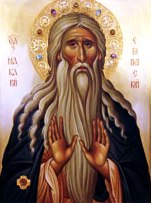
This Patristic breviary is available from Barnes & Noble
"One Heart that Seems Two
How is it possible for sin and grace to dwell in the same heart, as if
there were two different hearts?
The illustration of fire may help. If you have a fire below a vessel
and you put some wood on it, the fire flares up and the water in the
vessel heats up and boils. But if you fail to put more wood on the fire
it begins to fade gradually and goes out.
In our hearts is the heavenly fire of grace. If we pray and meditate
on the love of Christ, we add wood to the fire and our hearts burn
with longing for God.
If, on the contrary, we are negligent and give our attention to
worldly affairs, vice enters the heart, takes it over and torments us.
Nevertheless, the heart remembers the peace which it tasted earlier
and begins to repent, to direct itself afresh toward God. On the one
hand, then, peace is brought nearer, on the other, we are seeking it
fervently in prayer. It is like stirring the fire which is warming the
heart.
The vessel of the heart is very deep, so deep that the Bible says God
searches the abyss of it. If a person deviates from the way of God's
commandments, he puts himself under the power of sin. And because
the heart is a deep abyss, sin goes right down to it in order to take
over its territory. So it is necessary for grace also, slowly, to descend
to those depths."
Pseudo-Macarius, Homily 40:7
from 'Drinking from the Hidden Fountain' p.108-109, Edited by
Thomas Spidlik and Translated by Paul Drake, Cistertian
Publications 1994
Showing posts with label St Macarius. Show all posts
Friday, March 29, 2013
Sunday, January 13, 2013
Examining the Secret Things of the Heart
from the Orthodox blog, Ancient Christian Wisdom
January 13, 2013
“God has given you one face and you make yourself another.” (Hamlet, Shakespeare)
The human heart is so complex; we hardly know ourselves, let alone another human being. Yet, we spend a great deal of time analyzing and judging the actions and words of others, seeking out their secret motives and basically guessing in the dark. There are a number of reasons why we do this. Part of it is in order to predict what others will do, to protect ourselves in the future, to exonerate our own misbehavior, and to feel somehow superior to them in the present, since we really understand what makes them tick. Obviously, none of these aims helps us to grow in humility. We are like Ham thoughtlessly uncovering Noah’s nakedness, but carefully covering our own. Another reason for prying into the secret motives of others is that we prefer to avoid thoughtfully examining our own lives.
Self-examination takes effort, silence, and faith. The focus within requires more effort than letting our gaze wander on things around us. Self-examination requires silence and slowing down, for the noise of daily life and motion distract us continuously. It also requires faith, because we all fear what lurks inside our hearts—our secrets—those things that we scarcely even admit to ourselves. However, these are the depths to which the Gospel calls us. We are called by Jesus Christ our Master and Lord to plumb the depths of our own heart. He alone can command us to do this, for He alone knows the heart of man, knows its depth, and knows how splendid the heart can be when filled with His light. Saint Ambrose wrote, “The Lord knows all things, but he waits for your words, not in order to punish you, but to pardon you.” But how can we even confess our secret sins and perhaps unknown passions, unless we look deep into the secret recesses of the heart in order to really see them and know them?
It takes courage and receptivity to the promptings of the Holy Spirit to quiet our own heart and look within. Saint Macarius the Great teaches us, “The heart is but a small vessel, yet dragons are there, and there are lions also; there are poisonous beasts and all the treasures of evil. There also are rough and uneven roads; there are precipices. . . For our Lord Jesus Christ came for this reason, to change and transform and renew human nature and to recreate this soul that had been overturned by passions through the transgression. He came to mingle human nature with his own Spirit of the Godhead.”
Monday, March 12, 2012
The Way to Christ
Icon
of Christ in the Church of Agia Sophia, Istanbul, Turkey
Used with permission Dick Osseman
The
way to Christ is within and through the heart. If we desire to meet the Lord
Jesus Christ and have communion with Him we must
first purify our nous and
our innermost being, our heart, and in this way
prepare a holy habitation for
our Lord. Fr
Zacharias Zacharou, the blessed disciple of Elder Sophrony of
Essex, explains
in his book, 'The Hidden Man of the Heart' p.1, Edited
by
Christopher Veniamin Mount Thabor Publishing 2008; "All the ordinances
of the undefiled Church are offered to the world for the sole purpose
of discovering the deep heart (Ps.64:6) the center of man's hypostasis
(person). According
to the Holy Scriptures, God has fashioned every
heart in a special way, and each heart is His goal, a place wherein He
desires
to abide that He may manifest Himself.
Since the kingdom of God is within us
(Luke17:21), the heart is the
battlefield of our salvation, and all ascetic
effort is aimed at cleansing it
of all filthiness,
and preserving it pure before the Lord. 'Keep thy heart
of with all diligence;
for out of it are the issues of life', exhorts the wise
Solomon, the wise king of Israel (Prov.4:23). These paths of life pass
through man's heart, and therefore the unquenchable desire of
all who
ceaselessly seek the Face of the living God is that their heart, once
deadened by sin, may be rekindled by His
grace."
Our
great father among the saints, St. Macarius, whose words are so filled
with Grace, tells us in his Homily No. 13 that; "
All visible things God created,
and gave them to men for recreation and
enjoyment, and he gave them also
a law of justice.
But ever since Christ's coming, God demands other fruit
and another
righteousness, namely, a purity of heart, a
good
conscience, profitable speech, holy and good thoughts, and all the
works of
the saints. For the Lord says: "Unless your righteousness
exceeds that of the
Scribes and Pharisees, you cannot enter into the
Kingdom of Heaven. It is
written in the Law: Do
not commit adultery. But I tell you, Do not lust or be
angry" (Mt.
5:20 ff.).
For
it is necessary that he who truly desires to be a friend of God keep himself
from the mire of sin, but for the eternal fire which
is in us, (This refers to the
presence of the Holy Spirit as fire
within the human soul that accepts divine
grace and lives
in a way that becomes a living temple of the Holy Spirit. Cf.
Homily
25:9). This makes us worthy of the kingdom. Glory
to his mercy and to
his propitious will toward us, Father and Son and Holy
Spirit. Amen. From
Pseudo-Macarius, The Fifty Spiritual
Homilies and the Great Letter, p 104,
Translated and Edited by George
A. Maloney, S.J., Paulist Press 1992
And
in Homily 19 p. 146-147 St Macarius states that, "The person that
wishes
to come to the Lord and to be deemed worthy of eternal
life and to become the
dwelling place of Christ and to be filled with the
Holy Spirit so that he may be
able to bring forth the fruits
of the Spirit and perform the commandments of
Christ purely and blamelessly
ought to begin first by believing firmly
in the Lord
and giving himself completely to the words of his
commands and renouncing
the world in all things so that his whole
mind may not be taken up with anything
ephemeral. And he ought to
persevere constantly in prayer, always waiting in
faith
that expects his coming and his help, keeping the goal of his mind
ever
fixed upon this. Then he ought to push himself to every
good work and to doing
all the commandments of the Lord, because
there is sin dwelling within him.
Thus let him strive to show
humility before every person and to consider himself
the least and
the worst. Let him not seek honor or praise or the glory
of men as
it is written in the Gospel (John. 12:44).
But
let him only have always before his eyes the Lord and His commands,
wishing
to please him alone in the meekness of his heart
, as the Lord
says: "Learn of me, because I am meek and humble
of heart and you will find
rest for your souls" (Matthew
11:29). Likewise let him accustom himself to be
merciful, compassionate and
good according to his power, as the Lord says:
"Be
good and kind, even as your heavenly Father is merciful" (Luke 6:36). And
again he
says: "If you love me, keep my commandments" (John14:15).
And
again: "Strive to enter through the narrow door" (Luke 13:24). Above
all, let him
take the humility and conduct of the
Lord, his meekness and conversation, as
his model by ever remembering him.
Let him
continue incessantly in prayers, always beseeching and believing that
the Lord may come to dwell in him and may perfect and
give him power to
accomplish all his commands and that the Lord
himself may become the
dwelling place for his soul. And
thus the things he now does with effort of a
reluctant heart, he may perform
one day willingly, accustoming himself always
to the
good and remembering the Lord and waiting for him always in great love.
Then the Lord, seeing such an intention and his good diligence,
how he strives
to remember the Lord and always seeks to do good and is humble
and meek
and loving, how he guides his heart,
whether he wishes or not, to the best of his
ability with force, has mercy
on him and frees him from his enemies and the
indwelling
sin. He fills him with the Holy Spirit. And gradually, without force
or
struggle he keeps all of the Lord's commandments in
truth. Or, rather, it is the
Lord who keeps in him his very own commandments,
and then he brings forth
purely the fruits of the Spirit." From
Pseudo-Macarius, The Fifty Spiritual
Homilies and the
Great Letter, Translated and Edited by George A. Maloney,
S.J.,
Paulist Press 1992
Fr.
Zacharias continues, " The heart is the true temple of man's meeting with
the Lord. Man's heart 'seeketh knowledge' (Prov.15:14),
both intellectual and
divine, and knows no rest until the Lord of Glory comes
and abides therein.
On His part God,
Who is a 'jealous God' (Ex. 34:14) will not settle for a mere
portion of the
heart. In the Old Testament we hear His voice crying
out, 'My
son, give me thy heart' (Prov. 23:26); and in the New Testament He
commands: 'Thou shalt love the Lord thy God with
all thy heart, and with all thy
soul, and with all thy mind, and with all
thy strength.' (Matt. 12:30). He is the
One Who has fashioned
the heart of every man in an unique and unrepeatable
way, though no heart can
contain Him fully because 'God is greater than
our
heart' (1 John 3:20). Nevertheless when man succeeds in turning
his
whole heart to God, then God Himself begets
it by the incorruptible
seed of His word, seals it with His wondrous
Name, and makes it shine
with His perpetual and charismatic
presence. He makes it a temple of
His Divinity, a temple not made by
hands, able to reflect His 'shape'
and to hearken unto His 'voice' and 'bear' His Name (cf. John 5:37;
Acts 9:15).
In
a word, man then fulfills the purpose of his life, the reason for his
coming
into the transient existence of this world. The great tragedy
of our time lies
in the fact that we live, speak, think, and even pray to
God, outside our heart,
outside our Father's house. And truly our
Father's house is our
heart, the place where 'the spirit of glory and
of God' (1 Peter 4:14)
would find repose, that Christ may be 'formed
in us' (Gal. 4:19). Indeed
only then can we be made whole, and
become hypostases in the image of the true
and perfect Hypostasis,
the Son and Word of God , Who created us and
redeemed us by the
precious Blood of His ineffable sacrifice.
Yet,
as long as we are held captive by our passions, which distract our mind
from
our heart and lure it into the ever-changing and vain world
of natural
and created things, thus depriving us of all spiritual strength,
we will not know
the new birth from on High that
makes us children of God and gods by grace.
In fact, in one way or
another, we are all 'prodigal sons' of our Father in
heaven, because
as the Scriptures testify, 'All have sinned and come short of
the glory of God'
(Rom. 3:23). Sin has separated our mind from the
life-giving
contemplation of God and led it into a 'far country' (Luke
9:15). In this 'far
country' we have been deprived of the honour
of our Father's embrace and,
in feeding swine, we have been
made subject to demons. We gave ourselves
over to dishonorable
passions and the dreadful famine of sin, which then
established itself by
force, becoming the law of our members.
But
now we must come out of this godless hell and return to our Father's house
(our heart-emphasis mine) so as to uproot the law of
sin that is within us and
allow the law of Christ's commandments to dwell
in our heart. For the only path
leading out
of the torments of hell to the everlasting joy of the Kingdom is that
of the divine commandments: with our whole being we are
to love God and our
neighbor with a heart that is free of all sin. The
return journey from this remote
and inhospitable land is not
an easy one, and there is no hunger more fearful
than that of a heart laid
waste by sin. Those in whom the heart is full of the
consolation
of incorruptible grace can endure all external deprivations and
afflictions, transforming them into a feast of spiritual
joy; but the famine in a
hardened heart lacking divine consolation is a
comfortless torment. There is no
greater misfortune
than that of an insensible and petrified heart that is unable to
distinguish between the luminous Way of God's Providence
and the gloomy
confusion of the ways of this world.
On
the other hand, throughout history there have been men whose hearts were
filled with grace. These chosen vessels were enlightened
by the spirit of
prophecy, and were therefore able to distinguish between Divine
Light and the
darkness of this world. No
matter how daunting and difficult the struggle
of purifying the heart may
be, nothing should deter us from this
undertaking.
We have on our side the ineffable goodness of God Who
has made man's heart
His personal concern and goal.
From 'The
Hidden Man of the Heart' p.2-3, Edited by Christopher Veniamin,
Mount
Thabor Publishing 2008
Friday, October 15, 2010
The Way to Christ is Within and Through the Heart
Icon of Christ of Sinai in the Church of St Panteleimon, Thessaloniki, Greece
The way to Christ is within and through the heart. If we desire
to meet the Lord Jesus Christ and have communion with Him we
must first purify our nous and our innermost being, our heart, and
and in this way prepare a holy habitation for our Lord.
Fr Zacharias Zacharou, that blessed disciple of Elder Sophrony
of Essex, explains in his book, 'The Hidden Man of the Heart' p.1,
Edited by Christopher Veniamin Mount Thabor Publishing 2008;
"All the ordinances of the undefiled Church are offered to the
world for the sole purpose of discovering the deep heart (Ps.64:6)
the center of man's hypostasis (person). According to the Holy
Scriptures, God has fashioned every heart in a special way, and
each heart is His goal, a place wherein He desires to abide that
He may manifest Himself.
Since the kingdom of God is within us (Luke17:21), the heart
is the battlefield of our salvation, and all ascetic effort is aimed
at cleansing it of all filthiness, and preserving it pure before the
Lord. 'Keep thy heart of with all diligence; for out of it are the
issues of life', exhorts the wise Solomon, the wise king of Israel
(Prov.4:23). These paths of life pass through man's heart, and
therefore the unquenchable desire of all who ceaselessly seek
the Face of the living God is that their heart, once deadened by
sin, may be rekindled by His grace."
are so filled with Grace, tells us in his Homily No. 13 that;
" All visible things God created, and gave them to men for
recreation and enjoyment, and he gave them also a law of
justice. But ever since Christ's coming, God demands other
fruit and another righteousness, namely, a purity of heart,
a good conscience, profitable speech, holy and good thoughts,
and all the works of the saints. For the Lord says: "Unless your
righteousness exceeds that of the Scribes and Pharisees, you
cannot enter into the Kingdom of Heaven. It is written in the
Law: Do not commit adultery. But I tell you, Do not lust or be
angry" (Mt. 5:20 ff.).
For it is necessary that he who truly desires to be a friend of
God keep himself from the mire of sin, but for the eternal fire
which is in us, (This refers to the presence of the Holy Spirit
as fire within the human soul that accepts divine grace and
lives in a way that becomes a living temple of the Holy Spirit.
Cf. Homily 25:9). This makes us worthy of the kingdom.
Glory to his mercy and to his propitious will toward us, Father
and Son and Holy Spirit. Amen. From Pseudo-Macarius, The Fifty
Spiritual Homilies and the Great Letter, p 104, Translated and
Edited by George A. Maloney, S.J., Paulist Press 1992
And in Homily 19 p. 146-147 St Macarius states that, "The person
that wishes to come to the Lord and to be deemed worthy of
eternal life and to become the dwelling place of Christ and to be
filled with the Holy Spirit so that he may be able to bring
forth the fruits of the Spirit and perform the commandments
of Christ purely and blamelessly oughth to begin first by believing
firmly in the Lord and giving himself completely to the words of
his commands and renouncing the world in all things so that his
whole mind may not be taken up with anything ephemeral. And
he ought to persevere constantly in prayer, always waiting in
faith that expects his coming and his help, keeping the goal of
his mind ever fixed upon this. Then he ought to push himself to
every good work and to doing all the commandments of the Lord,
because there is sin dwelling within him. Thus let him strive to
show humility before every person and to consider himself the
least and the worst. Let him not seek honor or praise or the
glory of men as it is written in the Gospel (Jn. 12:44).
But let him only have always before his eyes the Lord and His
commands, wishing to please him alone in the meekness of his
heart , as the Lord says: "Learn of me, because I am meek and
humble of heart and you will find rest for your souls"
(Matthew 11:29).
Likewise let him accustom himself to be merciful, compassionate
and good according to his power, as the Lord says: "Be good and
kind, even as your heavenly Father is merciful" (Luke 6:36). And
again he says: "If you love me, keep my commandments"
(John14:15). And again: "Strive to enter through the narrow door"
(Luke 13:24). Above all, let him take the humility and conduct of
the Lord, his meekness and conversation, as his model by ever
remembering him.
Let him continue incessantly in prayers, always beseeching and
believing that the Lord may come to dwell in him and may perfect
and give him power to accomplish all his commands and that the
Lord himself may become the dwelling place for his soul.
And thus the things he now does with effort of a reluctant heart,
he may perform one day willingly, accustoming himself always to
the good and remembering the Lord and waiting for him always in
great love. Then the Lord, seeing such an intention and his good
diligence, how he strives to remember the Lord and always seeks
to do good and is humble and meek and loving, how he guides his
heart, whether he wishes or not, to the best of his ability with
force, has mercy on him and frees him from his enemies and the
indwelling sin. He fills him with the Holy Spirit. And gradually,
without force or struggle he keeps all of the Lord's commandments
in truth. Or, rather, it is the Lord who keeps in him his very own
commandments, and then he brings forth purely the fruits of the
Spirit." From Pseudo-Macarius, The Fifty Spiritual Homilies and the Great
Letter, Translated and Edited by George A. Maloney, S.J., Paulist Press 1992
Fr. Zacharias continues, " The heart is the true temple of man's
meeting with the Lord. Man's heart 'seeketh knowledge'
(Prov.15:14), both intellectual and divine, and knows no rest
until the Lord of Glory comes and abides therein. On His part
God, Who is a 'jealous God' (Ex. 34:14) will not settle for a mere
portion of the heart. In the Old Testament we hear His voice
crying out, 'My son, give me thy heart' (Prov. 23:26); and in the
New Testament He commands: 'Thou shalt love the Lord thy God
with all thy heart, and with all thy soul, and with all thy mind,
and with all thy strength.' (Matt. 12:30). He is the one Who has
fashioned the heart of every man in an unique and unrepeatable
way, though no heart can contain Him fully because 'God is
greater than our heart' (1 John 3:20). Nevertheless when man
succeeds in turning his whole heart to God, then God Himself
begets it by the incorruptible seed of His word, seals it with
His wondrows Name, and makes it shine with His perpetual
and charismatic presence. He makes it a temple of His
Divinity, a temple not made by hands, able to reflect His
'shape' and to hearken unto His 'voice' and 'bear' His Name
(cf. John 5:37; Acts 9:15). In a word, man then fulfills the
purpose of his life, the reason for his coming into the transient
existence of this world. The great tragedy of our time lies in the
fact that we live, speak, think, and even pray to God, outside our
heart, outside our Father's house. And truly our Father's house is
our heart, the place where 'the spirit of glory and of God' (1 Peter
4:14) would find repose, that Christ may be 'formed in us'
(Gal. 4:19). Indeed only then can we be made whole, and become
hypostases in the image of the true and perfect Hypostasis, the
Son and Word of God , Who created us and redeemed us by the
precious Blood of His ineffable sacrifice.
Yet, as long as we are held captiveby our passions, which distract
our mind from our heart and lure it into the ever-changing and
vain world of natural and created things, thus depriving us of all
spiritual strength, we will not know the new birth from on High
that makes us children of God and gods by grace. In fact, in one
way or another, we are all 'prodigal sons' of our Father in heaven,
because as the Scriptures testify, 'All have sinned and come short
of the glory of God' (Rom. 3:23). Sin has separated our mind from
the life-giving contemplation of God and led it into a 'far country'
(Luke 9:15). In this 'far country' we have been deprived of the
honour of our Father's embrace and, in feeding swine, we have
been made subject to demons. We gave ourselves over to
dishonorable passions and the dreadful famine of sin, which then
established itself by force, becoming the law of our members.
But now we must come out of this godless hell and return to our
Father's house (our heart-emphasis mine) so as to uproot the law
of sin that is within us and allow the law of Christ's
commandments to dwell in our heart. For the only path leading
out of the torments of hell to the everlasting joy of the Kingdom
is that of the divine commandments: with our whole being we
are to love God and our neighbour with a heart that is free of all
sin. The return journey from this remote and inhospitable land is
not an easy one, and there is no hunger more fearful than that of
a heart laid waste by sin. Those in whom the heart is full of the
consolation of incorruptible grace can endure all external
deprivations and afflictions, transforming them into a feast of
spiritual joy; but the famine in a hardened heart lacking divine
consolation is a comfortless torment. There is no greater
misfortune than that of an insensible and petrified heart that is
unable to distinguish between the luninous Way of God's
Providence and the gloomy confusion of the ways of this world.
On the other hand, throughout history there have been men
whose hearts were filled with grace. These chosen vessels were
enlightened by the spirit of prophecy, and were therefore able
to distinguish between Divine Light and the darkness of this
world. No matter how daunting and difficult the struggle of
purifying the heart may be, nothing should deter us from this
undertaking. We have on our side the ineffable goodness of
God Who has made man's heart His personal concern and goal.
From 'The Hidden Man of the Heart' p.2-3, Edited by Christopher Veniamin,
Mount Thabor Publishing 2008
Tuesday, June 22, 2010
St. Macarius of Egypt - A Guide to the Heart
St Macarios the Great
from here
Macarius was an Egyptian and one of the younger contemporaries of
Anthony the Great. His father was a priest. Out of obedience to his
parents, Macarius married. However, his wife died shortly thereafter
and he withdrew to the wilderness, where he spent sixty years in labor
and struggle, both inwardly and outwardly, for the Kingdom of Heaven.
When they asked him why he was so thin, both when he ate and when
he did not eat, he responded: "From the fear of God." So much did he
succeed in cleansing his mind of evil thoughts and desires, that God
bestowed upon him the abundant gift of miracle- working, so that he
even raised the dead from the graves. His humility amazed both men
and demons.
From The Prologue of Ochrid by St. Nikolai Velimirovich, vol 1 p.68-69,
SebastianPress 2008
"The writings attributed to St Macarius of Egypt are one of the main
sources of the philocalic tradition. St Macarius is the founder of semi-
eremiticism in the desert of Scetis (presently Wadi Natrum) in Lower
Egypt. (In the 'Homilies', St. Macarius) insists particularly on the role of
the heart and the place of the body in the spiritual life, on the different
aspects of the divine pedagogy toward man, and on the necessary
cooperation of divine action and human freedom so that baptismal
grace unfolds in this taste of God, "which is a powerful operation of the
Spirit that is exercised in the heart, with a feeling of certainty"
Homily 15,20 as quoted by Fr Placide Deseille in Orthodox Spirituality and the
Philokalia p.19-20, Translated by Anthony P. Gythiel, Eighth Day Press 2008
Homily 19 - Christians, wishing to advance and grow, ought to
push themselves toward every good so as to free themselves
from every habitual sin and be filled by the Holy Spirit.
1. The person that wishes to come to the Lord and to be deemed
worthy of eternal life and to become a dwelling place of Christ and to
be filled with the Holy Spirit so that he may be able to bring forth the
fruits of the Spirit and performs the commands of Christ purely and
blamelessly ought to begin first by believing firmly in the Lord and
giving himself completely to the words of his commands and renounc-
ing the world in all things so that his whole mind may not be taken up
with anything ephemeral. And he ought to persevere constantly in
prayer, always waiting in faith that expects his coming and his help,
keeping the goal of his mind ever fixed upon this. Then he ought to
push himself to every good work and to doing all the commandments
of the Lord, because there is sin dwelling within him. Thus let him strive
to show humility before every person and to consider himself the least
and the worst. Let him not seek honor or praise or the glory of men as
it is written in the Gospel (Jn. 12:44). But let him only have always
before his eyes the Lord and his commands, wishing to please him
alone in the meekness of his heart , as the Lord says: "Learn of me,
because I am meek and humble of heart and you will find rest for your
souls" Matthew 11:29)
2. Likewise let him accustom himself to be merciful, compassionate
and good according to his power, as the Lord says: "Be good and
kind, even as your heavenly Father is merciful" (Luke 6:36). And again
he says: "If you love me, keep my commandments" (John14:15).
And again: "Strive to enter through the narrow door" (Luke 13:24).
Above all, let him take the humility and conduct of the Lord, his meek-
ness and conversation, as his model by ever remembering him. Let
him continue incessantly in prayers, always beseeching and believing
that the Lord may come to dwell in him and may perfect and give him
power to accomplish all his commands and that the Lord himself may
become the dwelling place for his soul.
And thus the things he now does with effort of a reluctant heart, he may
perform one day willingly, accustoming himself always to the good and
remembering the Lord and waiting for him always in great love. Then
the Lord, seeing such an intention and his good diligence, how he
strives to remember the Lord and always seeks to do good and is
humble and meek and loving, how he guides his heart, whether he
wishes or not, to the best of his ability with force, has mercy on him
and frees him from his enemies and the indwelling sin. He fills him with
the Holy Spirit. And gradually, without force or struggle he keeps all of
the Lord's commandments in truth. Or, rather, it is the Lord who keeps
in him his very own commandments, and then he brings forth purely
the fruits of the Spirit.
3. It is, however, necessary at first for one coming to the Lord to
force himself thus to do good and, even if he should not in his
heart be so inclined , he must constantly await his mercy with
unshakened faith and push himself to love, even if he does not
have love. He ought to push himself to meekness, even if he
has none, to mercy and to have a merciful heart. He must force
himself to be disregarded, and when he is looked down upon by
others, let him rejoice. When he is made light of or dishonored,
let him not become angry according to the saying: "Beloved do
not avenge yourselves" (Rom.12:9). Let him push himself to
prayer even when he does not possess the prayer of the Spirit.
And so, God, seeing him striving so and pushing himself by
determination even if the heart is unwilling, gives him the authe-
ntic prayer of the Spirit, gives him true charity, true meekness,
"the bowels of mercies"(Col.3:12), true kindness, and, simply
put, fills him with the fruits of the Spirit.
4. If a person pushes himself to attain prayer alone, when he has none,
in order to attain its grace, without striving earnestly for meekness, and
humility and charity and all the other commandments of the Lord,
neither taking pains nor struggling and battling to succeed in these as
far as his choice and free will go, he may at times be given a grace of
prayer with some degree of repose and pleasure from the Spirit
according as he asks. But he has the same traits he had before. He
has no meekness because he did not seek it with effort and he did not
prepare himself beforehand to become meek. He has no humility,
since he did not ask for it and did not push himself to have it. He has
no charity toward all men because he was not concerned with it and
did not strive for it in his asking for the gift of prayer. And in doing his
work, he has no faith or trust in God, since he did not know that he was
without it. And he did not take pains to seek from the Lord for himself
to have a firm faith and an authentic trust.
5. For just as he forces himself to prayer even when unwilling, so
everyone must push himself likewise to trust, so also to humility, so
to charity, so to meekness, sincerity and simplicity, so "unto every
patience and long-suffering with joy" (Col.1:11), so also to regard
himself as little and to consider himself as poor and the least of all. He
strives not to speak without profit, but always to be concerned to speak
the things of God with mouth and heart. He is attentive not to become
angry and loud-mouthed according to the saying, "Let all bitterness
and anger and clamoring be put away from you, with all malice"
(Eph.4:31). He strives to live according to all the ways of the Lord, in
the practice of virtue and good and noble conduct, to possess all
manifestations of goodness, of humility, of meekness, never being
proud and high-minded and puffed up and never to speak against
anyone.
6. In all of these matters a person must push himself if he desires to
gain the approval of and be pleasing to Christ so that the Lord, seeing
his determination and purpose in forcing himself to all goodness and
simplicity and kindness and humility and charity and prayer with full
determination, may give himself completely to him. The Lord himself
does all of these things in truth in him without labor and force, which
before he could not perform, even by his own determination, because
of sin that indwelled in him. And now all the practice of virtues comes
to him as though the virtues are a part of his nature. The reason is
really that the Lord comes and dwells in him and he is in the Lord.
The Lord himself operates in him to accomplish his own
commandments, effortlessly now, filling him with the fruit of the Spirit.
But if anyone forces himself only to possess the virtue of prayer, until
he receives that gift from God, but does not similarly push himself
to those other virtues, he can not really perform them purely and
faultlessly. He must orientate himself toward what good he is capable
of doing.
Sometimes the divine grace comes to him as he is asking and
imploring. For God is good and kind and he gives to those who ask
him whatever they are seeking. If one does not strive to be good, does
not possess the virtues already mentioned and has not even prepared
himself for them, he loses grace which he has acquired and falls
because of pride, or he does not make progress nor increase in
the grace that came to him because he does not give himself
purposefully to the Lord's commandments. For the dwelling of place
and the repose of the Spirit is humility, charity, and meekness and the
other commandments of the Lord.
7. Therefore, it is necessary that whoever wishes truly to please God
and receive from him the heavenly grace of the Spirit and to grow
and to be perfected in the Holy Spirit should force himself to observe
the commandments of God and to make his heart submissive, even
if he is unwilling according to the saying, "Therefore, I observe all Thy
commandments and every falde way I abhor" (Psalm 119:128).
As one pushes and compels himself to persevere in prayer until he
succeeds, similarly, if he wishes and forces and compels himself to
practice all the virtues and develops a good habit, he thus asks and
begs of the Lord always. And obtaining his request and receiving a
taste for God and becoming a participator of the Holy Spirit, he makes
the gift given to him to increase and to thrive as he rests in humility,
in charity and in meekness.
8. The Spirit himself graces him with all of these virtues and teaches
him authentic prayer, authentic charity, authentic meekness, for which
he pushed himself and sought to possess them. And he had a concern
and thought about them and they were given him. And thus, growing
and becoming perfect in God, he is deemed worthy to become an heir
to the kingdom. For the humble person never falls. Where would
he fall since he is lower than all others? A proud mind is a great
humiliation, while humility is a great uplifting of the mind and an
honor and dignity. Let us then push ourselves and strive to
obtain humility, eventhough our heart is unwilling, to obtain
meekness and charity by praying and begging God in faith and
hope and love unceasingly with such expectancy and purpose
so that he may send his Spirit into our hearts in order that we
may pray and "worship God in spirit and in truth"(John 4:24).
9. Let us pray that the Spirit may teach us true prayer which now we
are unable to accomplish even through our earnest striving. He will
teach us how to accomplish, with hearts of compassion, kindness
and all the other commandments of the Lord truly without any trouble
and force since the Spirit himself knows how to fill us with his fruit.
And so we fulfill the commandments of God through his Spirit, who
alone knows the will of the Lord. The Spirit has perfected us in
himself and he is perfected in us as we are purified from all
defilement and stain of sin, as he presents us as beautiful
brides, pure and spotless, to Christ. We rest in God, in his
kingdom, and God rests in us for all ages unending.
Glory to his tender compassion and mercy and love that he
has deigned to bestow such honor and glory to the human
race and to deign to make them sons of the heavenly Father
and has called them his own brothers,
To Him be glory forever. Amen.
From Pseudo-Macarius, The Fifty Spiritual Homilies and the Great Letter
p.146-150, Translated and Edited by Fr. George A. Maloney, S.J.,
Paulist Press 1992
Subscribe to:
Posts (Atom)
Recommended Reading
- A Commentary On The Divine Liturgy by St. Nicholas Cabasilas, ISBN: 0-913836-37-0
- A Night in the Desert of the Holy Mountain by Metropolitan Hierotheos Vlachos Trans. by Effie Mavromichali, ISBN: 960-7070-31-3
- A Spiritual Psalter or Reflections On God excerpted by St. Theophan the Recluse from the works of St. Ephraim the Syrian, Trans. by Antonina Janda, ISBN 0-912927-40-2
- Against False Union ( with a prologue by Photios Kontoglou) by Alexander Kalomiros, Trans. by George Gabriel, ISBN: 0-913026-49-2
- Akathist To Jesus Conqueror of Death, by St Nikolai Velimirovich, Trans. by Interklima, Copyright 2009, English Edition, by St Paisius Monastery, Safford, AZ
- An Athonite Gerontikon by Archimandrite Ioannikios, Holy Monastery of St Gregory Palamas Kouphalia, Greece 1991
- Byzantine Theology by John Meyendorff, ISBN: 0-8232-0967-9
- Christ Our Way and Our Life by Archimandrite Zacharias Zacharou, ISBN 1-878997-74-2
- Christ The Eternal Tao by Hieromonk Damascene, ISBN 0-938635-85-9
- Commentary on The Gospel of St Luke by St Cyril of Alexandria Trans. by R.Payne Smith, Studion Publishers, Inc. ISBN:0-943670-01-2
- Concerning Frequent Communion by Nikodemos the Hagiorite, Trans. by George Dokos, ISBN: 960-86778-5-8
- Confronting Controlling Thoughts by Antony M. Coniaris, ISBN: ISBN: 1-880971-88-7
- Conversations with Children by Sister Magdalen, ISBN: 1-874679-21-5
- Counsels from the Holy Mountain by Elder Ephraim of Philotheou, ISBN: 0-9667000-2-3
- Daily Readings with St. Isaac of Syria, Trans. by Sebastian Brock, ISBM: 0-87243-173-8
- Dance, O Isaiah by Constantine Platis, unknown printing 2000
- Diary Of A Pilgrimage from the Ancient Christian Writers series, by Egeria, Trans. by George E. Gingras, ISBN: 0-8091-0029-0
- Drinking from the Hidden Fountain by Thomas Spidlik, ISBN: 0-87907-348-9
- Elder Ephraim of Katounakia Trans by Tessy Vassiliaou-Christodoulou, ISBN: 960-7407-33-4
- Elder Paisios of Mount Athos Spiritual Counsels, Spiritual Awakening vol 2, Trans by Fr. Peter Chamberas, Holy Monastery 'Evangelist John The Theologian' Souroti, Greece 2007
- Elder Paisios of Mount Athos Spiritual Counsels, With Pain And Love for Contemporay Man vol1, Trans by Cornelia A. Tsakiridou & Maria Spanou, Holy Monastery 'Evangelist John The Theologian' Souroti, Greece 2006
- Epistles by Elder Paisios of Mount Athos, Holy Monastery of the Evangelist John the Theologian, Souroti, Greece 2002
- Father Arseny Trans. by Vera Bouteneff, ISBN 0-88141-180-9
- Flame in the Snow, A Life of St Seraphim of Sarov by Julia de Beausobre, ISBN: 0-87243-223-8
- From St. Isaac The Syrian to Dostoyevsky by Archimandrite Vasileios, Trans. by Dr.Elizabeth Theokritoff, ISBN: 1-896800-34-3
- Grace For Grace: The Psalter And The Holy FathersCompiled and Edited by Johanna Manley, ISBN: 0-9622536-1-8
- Hesychia and Theology by Metropolitan Hierotheos Vlachos, Trans. by Sister Pelagia Selfe, ISBN: 978-960-7070-60-9
- His Life is Mine by Archimandrite Sophrony, ISBN: 0-913836-33-8
- I Love Therefore I Am by Fr. Nicholas V. Sakharov, ISBN: 0-88141-236-8
- In The Light of Christ, St Symeon The New Theologian by Archbishop Basil Krivocheine Trans. by Anthony P. Gythiel, ISBN 0-913836-91-5
- Isaac of Ninaveh ( Isaac The Syrian) The Second Part, chapters IV-XLV, Trans. by Sebastian Brock, ISBN: 90-6831-709-1
- Missionary Lettersof Saint Nikolai Velimirovich vol 1, Trans. by Hierodeacon Serafim, New Gracanica Monastery, Grayslake, IL
- Monastic Wisdom, The Letters of Elder Joseph The Hesychast, ISBN: 0-9667000-0-7
- Mount Athos Renewal in Paradise by Graham Speake, ISBN: 0-300-093535
- Nil SorskyTrans. and Edited by George A. Maloney, ISBN: 0-8091-9810-7
- Not of This World,Compiled and Edited by James S. Cutsinger, ISBN: 0-941532-41-0
- On Prayer by Archimandrite Sophrony Sakharov Trans.by Rosemar Edmonds, ISBN 0-88141-194-9
- On The Apostolic Preaching by St. Irenaeus of Lyons, Trans. by John Behr, ISBN: 0-88141-174-4
- On The Cosmic Mystery of Jesus Christ by St Maximus The Confessor, Trans. by Paul M. Blowers & Robert Louis Wilken, ISBN: 0-88141-249-x
- On The Human Condition by St Basil The GreatTrans. by Nonna Verna Harrison, ISBN: 0-88141-294-5
- On The Incarnation by St. Athanasius, ISBN: 0-913836-40-0
- On The Mother of God by Jacob of Serug, ISBN: 0-88141-184-1
- Once Delivered to The Saints by Fr. Michael Azkoul, ISBN: 0-913026-84-0
- Orthodox Faith and Life in Christ by Father Justin Popovich Trans. by Asterios Gerosterios, ISBN: 1-884729-02-9
- Orthodox Psychotherapy by Metropolitan Hierotheos Vlachos, Trans. by Esther Williams, ISBN: 960-7070-27-5
- Orthodox Spiritual Life According to Saint Silouan The Athonite by Harry Boosalis, ISBN: 1-878997-60-2
- Orthodox Spirituality and The Philokalia by Placide Deseille Trans. by Anthon P. Gythiel, ISBN 978-0-9717483-7-8
- Orthodox Spirituality by Metropolitan Hierotheos Vlachos, ISBN 960-7070-20-8
- Passions and Virtues According to Saint Gregory Palamas by Anestis Keselopulos, ISBN: 1-878997-75-0
- Patristic Theology by John S. Romanides, ISBN 978-960-86778-8-3
- Prayers by the Lake by St Nikolai Velimirovich, The Serbian Orthodox Metropolinate of New Gracanica, Grayslake, IL 1999
- Saint Cyril of Alexandria and the Christological Controversy by John McGuckin, ISBN: 0-88141-259-7
- Santa Biblia Antigua Version de Casiodoro De Reina Revisada por Cipriano de Valera(1602) Revision de 1960, Holman Publishers 2008
- St John of Damascus, The Fathers of the Church series, Trans. by Frederic H. Chase, Jr., ISBN: 0-8132-0968-4
- St Seraphim of Sarov, A Spiritual Biography by Archimandrite Lazarus Moore, ISBN: 1-880364-13-1
- St Silouan The Athonite by Archimandrite Sophrony, ISBN 0-88141-195-7
- St. Symeon The New Theologian, On The Mystical Life, The Ethical Discourses, Trans. by Alexander Golitzin 3 vols. ISBN: 0-88141-142-6 and - 143-4, and 144-2
- Standing In God's Holy Fire by John A. McGuckin, ISBN: 1-57075-382-2
- Symeon The New Theologian, The Discourses, Classics of Western Spirituality, ISBN: 0-8091-2230-8
- Symeon The New Theologian, The Practical and Theological Discourses and The Three Theological Chapters, Trans. by Dr. Paul McGuckin, Cistercian Publications Inc. 1982
- The Acquisition of The Holy Spirit by I.M. Kontzevitch, ISBN: 0-938635-73-5
- The Adam Complex by Dee Pennock, ISBN: 1-880971-89-5
- The Ascetical Homilies of Saint Isaac The Syrian, Trans. by Holy Transfiguration Monastery, ISBN: 0-913026-55-7
- The Authentic Seal by Archimandrite Aimilianos, ISBN: 960-85603-3-0
- The Book of Mystical Chapters, Trans. and introduced by John A. McGuckin, ISBN: 1-59030-007-6
- The Boundless Garden by Alexandros Papadiamantis Edited by Lambros Kamperidis and Denise Harvey, ISBN 978-960-7120-23-6
- The Church Fathers ( Ante-Nicene, Nicene and Post-Nicene Fathers, published by Hendrickson Publishers, Peabody Massachusetts, 37 vol. set
- The Enlargement of The Heart by Archimandrite Zacharias Zacharou, ISBN 0-9774983-2-8
- The Faith of Chosen People by St Nikolai Velimirovich, The Free Serbian Diocese of America and Canada, Grayslake, IL 1988
- The Faith of The Saints , A Catechism by St. Nikolai Velimirovich, ISBN:1-932965-06-8
- The Fifty Spiritual Homilies, Pseudo-Macarius, ISBN: 0-8091-0455-5
- The Gurus, the Young Man, and Elder Paisios by Dionysios Farasiotis, ISBN: 978-1-887904-16-2
- The Heart by Archimandrite Spyridon Logothetis, ISBN 960-86639-4-6
- The Hidden Man of The Heart by Archimandrite Zacharias Zacharou, ISBN 978-0-9800207-1-7
- The Holy Bible NKJV, Thomas Nelson, 1992
- The Homilies of Saint Gregory Palamas by Christopher Veniamin, 2 vols. ISBN: 1-878997-67-X; ISBN: 1-878997-68-X
- The Ladder of Divine Ascent by St. John Climacus Edited by Holy Transfifuration Monastery 1979, ISBN 0-943405-03-3
- The Life of St. Anthony by St. Athanasius the Great, Eastern Orthodox Books, Willits, CA
- The Lives of The Holy Prophets by Holy Apostles Convent, ISBN: 0944359-12-4
- The Living Witness of the Holy Mountain by Hieromonk Alexander Golitzin, ISBN: 1-878997-48-3
- The Luminus Eye by Sebastian Brock, ISBN: 0-87907-524-4
- The Mind of the Orthodox Church by Metropolitan Hierotheos Vlachos, Trans. by Esther Williams, ISBN: 960-7070-39-9
- The One Thing Needful by Archbishop Andrei of Novo- Diveevo, ISBN: 91-2927-29-1
- The Orthodox Ethos, Studies in Orthodoxy Edited by A.J. Philippou, Hollywell Press Oxford 1964
- The Orthodox New Testament 2 vols., Published by The Holy Apostles Convent 1999, ISBN: 0-944359-17-5 & 0-944359-14-0
- The Philokalia, The Complete Text compiled by St Nicodemos of the Holy Mountain and St Makarios of Corinth, Trans. by G.E.H. Palmer, Phillip Sherrard and Kallistos Ware Vol 4 ISBN: 0-571-11727-9
- The Philokalia, The Complete Text compiled by St Nicodemos of the Holy Mountain and St Makarios of Corinth, Trans. by G.E.H. Palmer, Phillip Sherrard and Kallistos Ware Vol2 ISBN: 0-571-15466-2
- The Philokalia, The Complete Text compiled by St Nicodemos of the Holy Mountain and St Makarios of Corinth, Trans. by G.E.H. Palmer, Phillip Sherrard and Kallistos WareVol 3 ISBN: 0-571-17525-2
- The Philokalia, The Complete Textcompiled by St Nicodemos of the Holy Mountain and St Makarios of Corinth, Trans. by G.E.H. Palmer, Phillip Sherrard and Kallistos Ware, Vol 1 ISBN: 0-571-13013-5
- The Philokalia: Master Reference Guide Compiled by Basileios S. Stapakis, Trans by G.E.H. Palmer, Phillip Sherrard, Kallistos Ware, ISBN: 1-880971-87-9
- The Prologue of Ohrid, Trans. by Fr. Timothy Tepsic, vol 1 ISBN: 978-0-9719505-0-4; vol 2 ISBN: 978-0-9719505-1-1
- The Psalter Trans. by Holy Transfiguration Monastery, ISBN: 0-943405-00-9
- The Spiritual World of St Isaac the Syrian by Bishop Hilarion Alfeyev, Cistercian Publications, Kalamazoo, Michigan 2000
- The Way of A Pilgrim trans.by R.M. French, ISBN 345-24254-8-150
- We Shall See Him As He Is by Archimandrite Sophrony Sakharov, ISBN 0-9512786-4-9
- Wisdom. Let Us Attend: Job, The Fathers, and The Old Testament by Johanna Manley, ISBN: 0-9622536-4-2
- Words of Life by Archimandrite Sophrony, Trans. by Sister Magdalen, ISBN1-874679-11-8
- Writings from The Philokalia On Prayer of The Heart, Trans. by E. Kadloubovsky and G.E.H. Palmer, ISBN: 0-571-16393-9