Showing posts with label humility. Show all posts
Showing posts with label humility. Show all posts
Wednesday, November 4, 2015


Saturday, May 2, 2015
The Fruit of Humility

Icon in the Church of Panagia Dexia
Thessaloniki, Greece
"Abba John the Short asked the monks: "Who sold Joseph?" One monk replied: "His brothers." To that, the elder replied: "No brethren, rather his humility. Joseph could have said that he is their brother and could have protested to being sold but he remained silent. His humility, therefore, sold him. Afterward, this same humility made him master over Egypt."
In surrendering ourselves to the will of God, we defend ourselves too much from external unpleasantness, that is why we lose the good fruits which is harvested at the end of unpleasantness endured with humility.
Abba Pimen wisely spoke: "We have abandoned the easy yoke, i.e., self-reproach and we have burdened ourselves with a heavy yoke, i.e., self-justification."
The Christian accepts every unpleasantness as deserving of their present or their past sins; seeking in all, the will of God with faith and awaiting the end with hope."Reading from the Prologue of Ochrid for May 3rd by St Nikolai Velimirovich
Wednesday, February 11, 2015
Humility, a Wondrous Virtue of a Godly Soul


That Those Who Abase Themselves Will Be Honored by God
I just read a story in the Prologue of Ochrid, which is told in further detail in the Evergetinos vol.2,p.4-7, and I can't stop thinking about it. O, that one could have eyes to see and value what God values, and not what men hold in honor!
"As a simple charcoal-burner, Alexander lived in the town of Comana near Neo-Caesarea. When the bishop of Comana died, St. Gregory the miracle-worker and Bishop of Neo-Caesarea (November 17 in the Prologue) was then called to preside at a council to elect a new bishop. Both clergy and laymen alike were present at the council. However, the electors were unable to agree on one person. At the time of evaluating a candidate, they all primarily paid attention to the points of his externals: external dignity and behavior.
St. Gregory then said that they need not look so much at the external characteristics as much as at the spirit and spiritual capabilities. Then some jesters mocking cried out: then we should elect Alexander the charcoal-burner as our bishop! General laughter then ensued. St. Gregory asked: "Who is this Alexander?" And, thinking that his name was not mentioned at this council without God's Providence, Gregory ordered that Alexander be brought before the council", from The Prologue of Ochrid reading for August 12
The Evergetinos continues, "Thereupon, one of those present, laughing with derision, brought in their midst Alexander, who was wearing sorry-looking rags that did not even cover his whole body; his appearance gave evidence of his profession. His hands and his face, as well as the reminder of his body, ...were covered with grime. The sight of one such as Alexander, standing among them, gave all the others and occasion to laugh. Through the clairvoyant eyes of St. Gregory, however, what was happening created surprise and amazement in his soul.
This man, so poor and so unkempt in body, was self-composed and seemed to be rejoicing at all that which to his ignorant detractors was laughable. And it was so...he was a philosopher..., he concealed himself behind the most humble of occupations...even though he was in the flower of his youth,...he trained his body in virtue at his workplace, and the beauty of his youth he covered in soot from the coal.
St Gregory, having called Alexander out of the assembly of leaders (gave instructions to the servants to wash him)...Returning they had Alexander with the, having bathed and cleaned the soot from him, and he was wearing the Saint's (St Gregory's) vesture.(on his orders).
While all present turned their eyes toward Alexander and were astonished by what they saw, the Teacher said to them: 'There is nothing unusual about being misled by one's eyes,...it was certainly clear to the enemy of piety, the devil, that the nomination process would be rendered ineffective by a lack of knowledge, so that there might not be made manifest therein a person to abrogate his tyranny.
Having said this, the saint dedicated Alexander to God through the priesthood, sealing him, in keeping with the manner dictated by the holy canons, with Divine Grace."
"SAINT ALEXANDER, BISHOP OF COMANA
Men look upon clothes and the face,
But God looks at the soul and the heart.
Glorious Alexander, a charcoal-burner, was,
With the charcoal-burner, the body is blackened
And from soot, which water cleanses,
In the sinner, the heart is darkened
Which only the fire of faith can cleanse
The fire of faith and the cry of repentance.
It is easier to cleanse the skin of a charcoal-burner
Than the blackened heart of a sinner.
Alexander, with humility, covered
In a cave concealed, as a hidden flame
For laughter, to the gullible world, he was.
The world did not see; Gregory saw,
With an acute spirit, the charcoal-burner discerned
And in him, found a saint,
In the dark cave, a beautiful flame,
Beneath the mask of insanity, great wisdom,
Beneath the dirty soot, a pure heart,
A royal soul in decayed rags.
That the light be hidden, the Lord does not permit,
At the appropriate time, the light proclaims,
For the benefit and salvation of men.
All is wonderful, what God judges."
Sunday, December 7, 2014
Elder Ephraim of Arizona: On Slander & Condemnation
Source Pemptousia

"Slander is a great evil. Just as the little rudder steers the whole ship wherever it wants, likewise the tongue leads a person either to good or to evil. The holy fathers greatly censure judging other people’s sins, faults, or evil habits.
When we judge our brother, we condemn ourselves to a great sin. But when we cover our brother, God will also protect us from great sins. When we expose our brother, we drive the grace of God away from us and He permits us to fall into the same sins so that we learn that we are all weak and that the grace of God supports us.
Whoever guards his tongue guards his soul from great sins and grievous falls. The chief cause of criticism and slander is pride and egotism, because one considers oneself better than the others. For this reason it is very beneficial for a person to think of himself as below everyone, so that he considers his brother than him in order that, with the help of God, he may be delivered from this evil.
If something pushes you to criticism in any matter regarding a brother or the monastery, try to pray about the matter instead, without passing it under the judgment of your reason. If you turn within yourself through prayer, humility, and mourning, you will find a spiritual treasure—just keep pride and criticism far from you.
Be attentive, my child, that you not judge any soul. For God permits the one who judges his neighbor to fall, so that he learns to have sympathy for his weak brother. The mercy of God supports all of us, but if we become proud, God will remove His grace and we shall become worse than the others. It is one thing to condemn someone and another to be fought by thoughts of condemnation. To condemn is a terrible passion, but to be fought by such thoughts and to fight back—this is an occasion for crowns.
Each person must bear the weaknesses of others. Who is perfect? Who can boast that he has kept his heart undefiled? Hence, we are all sick, and whoever condemns his brother does not perceive that he himself is sick, because a sick person does not condemn another sick person.
Love, endure, overlook, do not get angry, do not flare up, forgive one another, so that you resemble our Christ and are counted worthy to be near Him in His kingdom. My children, avoid condemnation—it is a very great sin. God is greatly saddened when we condemn and loathe people. Let us concern ourselves only with our own faults—for these we should feel pain. Let us condemn ourselves and then we shall find mercy and grace from God.
Love one another, and do not be embittered out of egotism. Humility is a sure guide; it does not let the one who possesses it hit the reefs of carelessness and be shipwrecked, but as a luminous guide it leads him faultlessly on sure ground. Egotism is the most evil of evils; it causes all our lapses through un-submissive thoughts. Fear this and strive to get rid of it, for the more it remains within us, the more it will wound us with the proportionate pain. I beg that you not criticize one another, for this is downright egotism.
Excuse your brother’s fault; this is evidence of humility and love. The brother who acts thus will find much grace from God, but he who judges and scandalizes his neighbor should know that not only will he not find grace, but even if he has something he will lose it, so that he may learn the lesson of humility through suffering. Be particularly afraid of inner criticism, that is, thoughts of criticism, because it does not come to light through the spoken word, in which case it is likely to be corrected by someone who hears it.
Be careful, I say, about criticism from within, which imperceptibly makes us fatally guilty and deprives us of the life of divine grace and offers as a most bitter drink the death of the soul. I pray that love and freedom from criticism will reign in every expression among you, so that the Holy Spirit may rest in your souls.
To read the post in full, please go here
When we judge our brother, we condemn ourselves to a great sin. But when we cover our brother, God will also protect us from great sins. When we expose our brother, we drive the grace of God away from us and He permits us to fall into the same sins so that we learn that we are all weak and that the grace of God supports us.
Whoever guards his tongue guards his soul from great sins and grievous falls. The chief cause of criticism and slander is pride and egotism, because one considers oneself better than the others. For this reason it is very beneficial for a person to think of himself as below everyone, so that he considers his brother than him in order that, with the help of God, he may be delivered from this evil.
If something pushes you to criticism in any matter regarding a brother or the monastery, try to pray about the matter instead, without passing it under the judgment of your reason. If you turn within yourself through prayer, humility, and mourning, you will find a spiritual treasure—just keep pride and criticism far from you.
Be attentive, my child, that you not judge any soul. For God permits the one who judges his neighbor to fall, so that he learns to have sympathy for his weak brother. The mercy of God supports all of us, but if we become proud, God will remove His grace and we shall become worse than the others. It is one thing to condemn someone and another to be fought by thoughts of condemnation. To condemn is a terrible passion, but to be fought by such thoughts and to fight back—this is an occasion for crowns.
Each person must bear the weaknesses of others. Who is perfect? Who can boast that he has kept his heart undefiled? Hence, we are all sick, and whoever condemns his brother does not perceive that he himself is sick, because a sick person does not condemn another sick person.
Love, endure, overlook, do not get angry, do not flare up, forgive one another, so that you resemble our Christ and are counted worthy to be near Him in His kingdom. My children, avoid condemnation—it is a very great sin. God is greatly saddened when we condemn and loathe people. Let us concern ourselves only with our own faults—for these we should feel pain. Let us condemn ourselves and then we shall find mercy and grace from God.
Love one another, and do not be embittered out of egotism. Humility is a sure guide; it does not let the one who possesses it hit the reefs of carelessness and be shipwrecked, but as a luminous guide it leads him faultlessly on sure ground. Egotism is the most evil of evils; it causes all our lapses through un-submissive thoughts. Fear this and strive to get rid of it, for the more it remains within us, the more it will wound us with the proportionate pain. I beg that you not criticize one another, for this is downright egotism.
Excuse your brother’s fault; this is evidence of humility and love. The brother who acts thus will find much grace from God, but he who judges and scandalizes his neighbor should know that not only will he not find grace, but even if he has something he will lose it, so that he may learn the lesson of humility through suffering. Be particularly afraid of inner criticism, that is, thoughts of criticism, because it does not come to light through the spoken word, in which case it is likely to be corrected by someone who hears it.
Be careful, I say, about criticism from within, which imperceptibly makes us fatally guilty and deprives us of the life of divine grace and offers as a most bitter drink the death of the soul. I pray that love and freedom from criticism will reign in every expression among you, so that the Holy Spirit may rest in your souls.
To read the post in full, please go here
Tuesday, September 9, 2014
How to Avoid becoming Prideful because of our Good Deeds

"One should not give alms with pride but rather with humility,
considering the one to whom the alms are given to be better
than oneself. Did not the Lord Himself say: Inasmuch as ye
have done it unto one of the least of these My brethren, ye
have done it unto Me? (Matthew 25:40)
Theophanes the Confessor possessed a mind illumined by the
light of Christ, even as a child. Once, while walking along the
street, he saw a naked child freezing. He quickly removed his
clothes, clothed the child and thus warmed him and brought
him back to life. He then returned home naked.
His startled parents asked him: ``Where are your clothes?''
To this Theophanes replied: ``I clothed Christ.'' This is why
he was given the grace of Christ, and was later a great
ascetic, a sufferer for the Christian Faith and a miracle-
worker.
Often, when we give alms, either in someone else's name
or in our own name, we cannot avoid pride which, as soon
as it appears in the heart, destroys all the good deeds
performed.
When we give to the beggar as to a beggar and
When we give to the beggar as to a beggar and
not as to Christ, we cannot avoid pride or disdain. What
value is there in performing an act of mercy, while taking
pride in ourselves and disdaining the man?
Virtue is not a virtue when it is mixed with sin, just as milk is not milk when it is mixed with gasoline or vinegar." St Nikolai Velimirovich in The Prologue from Ochrid
Virtue is not a virtue when it is mixed with sin, just as milk is not milk when it is mixed with gasoline or vinegar." St Nikolai Velimirovich in The Prologue from Ochrid
Reading for September 9th.
Thursday, April 24, 2014
Humility leads to Perfect Rest in God

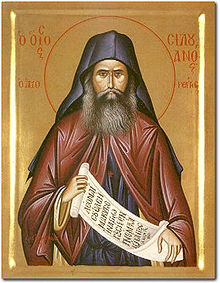
St Silouan the Athonite and behind him Archimandrite Sophrony
of Essex (Αγιορειτική Φωτοθηκή)Source
"Thou shalt not hate thy brother in thine heart...
and thou shalt love thy neighbour as thyself;
I am the Lord"
Brenton's Septuagint Leviticus 19:17-18, p.154
"Prayer is the best of all activities for the soul. Prayer
is the path to God. Through prayer we obtain humility,
patience and every good gift...
The Lord showed great pity on me and made me
understand that I must weep all my life. Such is the way
of the Lord. And so I write now out of pity for those who
like me, are puffed up with pride, and therefore suffer. I
write that they may learn humility and find rest in God...
Only to the humble does the Lord reveal Himself in the
Holy Spirit, and if we do not humble ourselves we shall
not see God. Humility is the light in which we may behold
the Light which is God - in the words of the Psalmist:
'In thy light shall we see light' Psalm 36:9...
The humility of Christ dwells in the lowly ones - they are
glad to be the least of men. The Lord gave me understanding
of this...
Be obedient, submit with a good conscience to those in
authority. Be content with all things, and your mind will be
cleansed of vain thoughts. Remember that the Lord sees
you, and be fearful lest anywise you offend your brother.
Neither dispraise nor grieve him, even by a glance, an
expression on your face, and the Holy Spirit will love you
and Himself be your help in all things...
If you have upbraided, or passed judgment on, or
vexed your brother, your peace is lost. If you have
been boastful, or have exalted yourself above your fellow,
you have lost grace. If you did not drive away forthwith
(immediately) that wanton (merciless and capricious)
thought that came to you, your soul will lose love for God
and boldness in prayer.
If you are fond of power, or money, you will never know the
love of God. If you have followed your own will, then you are
vanquished by the enemy and despondency will come upon
your soul. If you detest your brother, it means that
you have fallen away from God, and an evil spirit
has taken possession of you...
The grace of God is not in the man who does not love his
enemies...
There are people who desire the destruction, the torment
in hell-fire of their enemies, or the enemies of the Church.
They think like this because they have not learnt divine love
from the Holy Spirit, for he who has learned the love of God
will shed tears for the whole world...
But if you will do good unto your brother, you will
gain quiet for your conscience. If you subdue your own
will, your enemies will be driven off and you will receive
peace in your soul. If you forgive your brother the affronts
he puts upon you, and love your enemies, then you will
receive forgiveness for your sins and the Lord will give you
to know the love of the Holy Spirit...
And when you have entirely humbled yourself, you
will find perfect rest in God.
The Lord reveals His mysteries to the humble soul. But if the
soul has not yet learned but is only learning humility, she will
be subject to vicissitudes; at times she will find herself in
conflict with intrusive thoughts, and know no rest, while at
others she is released from such thoughts, and can
contemplate the Lord and perceive His love. Wherefore the
Lord said: 'Learn of me; for I am meek and lowly in heart;
and ye shall find rest unto your souls' Matthew 11:29...
Oh Lord. grant me Thy spirit of humility that I lose not Thy
grace again, and weep for it as Adam wept for paradise and
for God....
Therefore brethren, with all your might preserve the peace
of God which is freely given to us, and when any man vexes
us, if needs be let us constrain ourselves to love him, and
the Lord, seeing our pains, will help us with His grace..."
With St Silouan, let us pray:
"O Lord in Thy manifold mercy bestow on us
a humble spirit, that our souls may find rest in Thee.
Most holy and gracious Mother of God, beseech God
to make us lowly in spirit.
All ye saints who dwell in heaven
and behold the glory of the Lord
and your spirits rejoice -
pray that we also may be with you,
for my soul, too, would fain see the Lord,
and yearns after Him humbly,
knowing herself unworthy of such blessing.
O merciful Lord, by Thy Holy Spirit
teach us Thy humility."
St. Silouan the Athonite in St Silouan the Athonite by
Archimandrite Sophrony, Selections from p.269-p.504,
St Vladimir Seminary Press 1991.

St Silouan sited, and holding a prayer rope
Source
Friday, March 21, 2014
"Someone Who has Actually Tasted Truth is not Contentious for Truth" by St Isaac the Syrian
Have Peace in your Heart by St Isaac of Syria

I found a most amazing passage from the writings of St Isaac of Syria, in a little booklet entitled, "Daily Readings with St Isaac of Syria", Introduced and edited by A. M. Allchin, Translated by Sebastian Brock, Templegate Publishers, Springfield Illinois 1990
It reads, " Someone who has actually tasted truth is not contentious for truth.
Someone who is considered among men to be zealous for truth has not yet learned what truth is really like: once he has truly learnt it, he will cease from zealousness on its behalf.
The gift from God and of knowledge of him is not a cause for turmoil and clamour; rather this gift is entirely filled with a peace in which the Spirit, love and humility reside.
The following is a sign of the coming of the Spirit; the person whom the Spirit has overshadowed is made perfect in these very virtues.
God is reality. The person whose mind has become aware of God does not even possess a tongue with which to speak, but God resides in his heart in great serenity. He experiences no stirring of zeal
or argumentativeness, nor is he stirred by anger. He cannot even be aroused concerning the faith." p.61 translated by Dr. Sebastian Brock.
Of course, reading something like this has to make one wonder, How often do we state the truth with such passion even anger, as if Truth which is Reality Itself, was so fragile it needed our protection? Or even worse, what if all we are doing by affirming Truth (or our
misunderstanding of it as mere facts) is affirming our egos, our self-image and asserting ourselves in dominance over those around us?
We do well if, before we speak or act, we pause for a moment and make an honest assessment of our emotional and spiritual state. We do even better if, more than anything else, we pursue a first-hand personal experience of this Ultimate Reality, our Triune
God in a spirit of peace, humility and love.
This longing for the Truth must be first and foremost a longing for the transformation of our own hearts, that the prayer of our Lord Jesus Christ be fulfilled in us, when He prayed,
"Sanctify them in the truth; Your word is truth. As You sent Me into the world, I also have sent them into the world. For their sakes I sanctify Myself, that they themselves also may be sanctified in truth."
John 17:17-19 NASB
Which means;
Sanctify them (Make them holy, preserve them in holiness, restore them to spiritual health)
in the truth (in Me- "I am the way, and the truth, and the life; no one comes to the Father but through Me" John 14:6; John 15:15, "apart from Me you can do nothing".)
Your Word is truth ( "In the beginning was the Word and the Word was with God, and the Word was God John 1:1. Again the Lord is saying, "I am the Word of God and I am the Truth")
As you sent Me (the Word of the Father and the Truth) into the world, I also have sent them into the world (we must become, by Grace, the very Word of God to our generation, the Truth of God to our generation, not merely as ideology but in our
very beings, we must become a healing presence to those who are broken and ill with the sickness of sin!)
For their sakes I sanctify Myself (I offer Myself on the cross for their healing and restoration )
that they themselves also be sanctified in truth (that they themselves be made holy- be healed- in Me)

With compunction of heart we must entreat our Lord Jesus Christ and pray,
"Sanctify me by your mysteries, illumine my mind with knowledge of you, cause your hope to shine forth in my heart, deem me worthy to supplicate for it, God my Father and Lord of my life;illumine your lamp within me, place in me what belongs to you so that I may forget what belongs to myself.
Cast upon me the constraint of wonder at you, so that the constraint of nature may be overpowered by it. Stir upon within me the vision of your mysteries so that I may become aware of what was placed in me at holy baptism.
You have placed within me a guide: may he show me your glory at all times. You made me to be light and salt for the world: may I not prove a stumbling-block for my companions.
Seeing that I have left the world, may I never again look back to it and to the things which I renounced when I made my promise to you.
Cast reigns of delight upon my heart, so that my senses may not gaze beyond the paths of your law. Rig together my impulses for the ship of repentance, so that in it I may exult as I travel over the world's sea until I reach the haven of your hope.
When I am tempted, may my mind take courage from the recollection of you. Illumine the dark path before me by the brilliance that comes from awareness of you,"
St Isaac the Syrian, The Prayers of St Isaac the Syrian p.16, Trans. by Sebastian Brock, Divine Ascent Press 2011.
Monday, June 17, 2013
Have Peace in your Heart by St Isaac of Syria
I found a most amazing passage from the writings of St Isaac of Syria,
in a little booklet entitled, "Daily Readings with St Isaac of Syria",
Introduced and edited by A. M. Allchin, Translated by Sebastian
Brock, Templegate Publishers, Springfield Illinois 1990
It reads, " Someone who has actually tasted truth is not
contentious for truth.
Someone who is considered among men to be zealous for truth has
not yet learned what truth is really like: once he has truly learnt it,
he will cease from zealousness on its behalf.
The gift from God and of knowledge of him is not a cause for turmoil
and clamour; rather this gift is entirely filled with a peace in
which the Spirit, love and humility reside.
The following is a sign of the coming of the Spirit; the person whom
the Spirit has overshadowed is made perfect in these very virtues.
God is reality. The person whose mind has become aware of God
does not even possess a tongue with which to speak, but God resides
in his heart in great serenity. He experiences no stirring of zeal
or argumentativeness, nor is he stirred by anger. He cannot even be
aroused concerning the faith." p.61 translated by Dr. Sebastian Brock.
Of course, reading something like this has to make one wonder, How
often do we state the truth with such passion even anger, as if Truth
which is Reality Itself, was so fragile it needed our protection? Or
even worse, what if all we are doing by affirming Truth (or our
misunderstanding of it as mere facts) is affirming our egos, our self-
image and asserting ourselves in dominance over those around us?
We do well if, before we speak or act, we pause for a moment and
make an honest assessment of our emotional and spiritual state.
We do even better if, more than anything else, we pursue a first-
hand personal experience of this Ultimate Reality, our Triune
God in a spirit of peace, humility and love.
This longing for the Truth must be first and foremost a longing for
the transformation of our own hearts, that the prayer of our Lord
Jesus Christ be fulfilled in us, when He prayed,
"Sanctify them in the truth; Your word is truth. As You sent Me into
the world, I also have sent them into the world. For their sakes I
sanctify Myself, that they themselves also may be sanctified in
truth." John 17:17-19 NASB
Which means;
Sanctify them (Make them holy, preserve them in holiness, restore
them to spiritual health)
in the truth (in Me- "I am the way, and the truth, and the life; no
one comes to the Father but through Me" John 14:6; John 15:15,
"apart from Me you can do nothing".)
Your Word is truth ( "In the beginning was the Word and the
Word was with God, and the Word was God John 1:1. Again the
Lord is saying, "I am the Word of God and I am the Truth")
As you sent Me (the Word of the Father and the Truth) into
the world, I also have sent them into the world (we must
become, by Grace, the very Word of God to our generation, the
Truth of God to our generation, not merely as ideology but in our
very beings, we must become a healing presence to those who are
broken and ill with the sickness of sin!)
For their sakes I sanctify Myself (I offer Myself on the cross
for their healing and restoration )
that they themselves also be sanctified in truth (that they
themselves be made holy- be healed- in Me)

Which means;
Sanctify them (Make them holy, preserve them in holiness, restore
them to spiritual health)
in the truth (in Me- "I am the way, and the truth, and the life; no
one comes to the Father but through Me" John 14:6; John 15:15,
"apart from Me you can do nothing".)
Your Word is truth ( "In the beginning was the Word and the
Word was with God, and the Word was God John 1:1. Again the
Lord is saying, "I am the Word of God and I am the Truth")
As you sent Me (the Word of the Father and the Truth) into
the world, I also have sent them into the world (we must
become, by Grace, the very Word of God to our generation, the
Truth of God to our generation, not merely as ideology but in our
very beings, we must become a healing presence to those who are
broken and ill with the sickness of sin!)
For their sakes I sanctify Myself (I offer Myself on the cross
for their healing and restoration )
that they themselves also be sanctified in truth (that they
themselves be made holy- be healed- in Me)
This book is available from Amazon
Thursday, July 12, 2012
Humility by Elder Sergei of Vanves

This book is available from St John's Monastery Bookstore
"Humility is both the foundation of the spiritual life, and along with
"Humility is both the foundation of the spiritual life, and along with
love, its peak.
God resists the proud, but He gives His Grace to the humble. The
Elder repeated the teaching of St Isaac the Syrian, who said that
no one can approach God except through humility. Without
humility we cannot do anything at all. Without humility, our
entire spiritual life becomes utterly meaningless and all of our
other virtues become totally worthless. Therefore we must
seek humility above all. Humility along with love is one
of the higher, more direct paths to salvation.
We must seek humility rather than holiness, because any
holiness we might acquire without humility is nothing but
vain pretension. After all, the demons are nothing but fallen
angels who were perfect by virtue of being angels, but who became
demons by forgetting humility. This very same fate shall
be ours if we look for holiness without first acquiring
humility.
We should test our level of humility not just before
God but before our neighbor. We do this by not
concerning ourselves with our neighbor's reactions
to our humility, meaning that we shouldn't be upset
by our neighbor's sense of superiority when he
encounters our humility nor should we fear that we
will be abused because of our humility. The Elder
remarked that there were many men in the past who
profited from the humility of the saints. The only thing
that matters to the humble man is what God thinks
of our attitude."
Elder Sergei of Vanves, Life & Teachings p.76-77 , by
Jean-Claude Larchet, Divine Ascent Press,
Manton, CA 2012
Thursday, May 3, 2012
Thoughts and Deception by Archimandrite Sophrony

Those who want to pray with a cleansed mind (nous) must not concern themselves with the latest news from the newspapers, or read books that are irrelevant to our spiritual life – especially those books that arouse the passions – and they must not strive to learn out of curiosity whatever pertains to the lives of others. All these things bring foreign thoughts to mind, and when a person attempts to elucidate them, they confound his mind even more.
When the soul is taught love by God, then it will feel sorrow for all of Mankind, all of Creation, and will pray that everyone might repent and receive the grace of the Holy Spirit. But, should the soul lose this grace, love will abandon it (because without the grace of God, it is impossible to love one’s enemy) and that is when wicked thoughts will issue from the heart, as the Lord had said (Matthew 15:19, Mark 7:21-22).
Without the humility of Christ, Man’s nous (mind) will not be cleansed and his soul will never feel reposed in God, but will always be agitated by various thoughts that will hinder his “theoria” (sighting) of God. Ah, the humility according to Christ! Those who have tried it, rush towards God, insatiably, day and night!
Ah, but what a weakling I am! I have been writing for just a short while, and yet I have quickly become tired, and my body yearns to rest. But even the Lord Himself, when He was on earth “in His flesh”, was familiar with human frailty. He, the Merciful One, would also feel weary after His journeys on foot, and He had also slept on board a boat during the tempest; and, after the disciples had roused Him from His sleep, He commanded the sea and the wind to become still, and a great calm followed. So it is with our soul, whenever we call upon the most Holy Name of the Lord: a great calm follows.
Allow us, o Lord, to glorify You, until our dying breath…..
One can fall into deception, either out of inexperience, or out of pride. And if it is out of inexperience, the Lord heals the deceived one very quickly; however, if it is on account of pride, then the soul will be struggling for a very long time, until it has learnt humility and will then be healed by the Lord.
We fall into a deception, when we consider ourselves more prudent and experienced than the others – even our own spiritual father. This is what I myself had thought -in my inexperience- and this was the reason that I suffered. And I thank the Lord from my heart, because in this way, He humbled me and admonished me, and did not revoke His mercy from me. Now it occurs to me that without confessing to our spiritual father, it will not be possible to avoid deception, because it was to the spiritual father that God gave the gift of “binding and unbinding”.
If you sense light inside you or around you, do not believe in it unless you also have a deep solemnity within you for God and a love for your fellow man. However, do not be afraid; only humble yourself, and that light will disappear.
Should you see a certain vision or dream, do not trust it, for if it was from God, the Lord Himself will inform you about it. A soul that has not tasted of the Holy Spirit cannot discern where the vision comes from. The enemy will give the soul a “sweet sensation” combined with vainglory, and it is from this, that deception will have become evident.
The Fathers say that when a vision is a hostile one, the soul feels confusion or fear; but this will happen only to the humble soul that considers itself unworthy of a vision. The vainglorious person however, may not feel either fear or confusion, because he is desirous of visions and regards himself as worthy of them, which is why the enemy can easily deceive him.
Celestial things are recognized through the Holy Spirit and terrestrial things through one’s physical state. Whosoever attempts to know God through the physical mind is deceived, because God can only be known via the Holy Spirit.
If you see demons with your mind, then humble yourself and try not to look, and run as fast as you can to your spiritual Geron (Elder), to whom you have surrendered yourself. Tell him everything, and the Lord will then show His mercy on you and you will be rescued from that deception. But if you believe that you know more about spiritual matters than your spiritual father and you cease to tell him whatever is happening to you, then, because of this act of pride, inevitably, a certain trial will “befall” you, in order to restore your prudence.
Fight your enemies with humility.
When you see another mind struggling with your mind, then humble yourself and the struggle will cease.
If you happen to see demons, do not be afraid, but humble yourself and the demons will disappear. But if fear does overcome you, you will not avoid suffering some harm. Be brave. Remember that the Lord can see you, if you have hinged your hopes on Him.
But, for the soul to acquire respite from the demons, it must humble itself and say: “I am worse than all the others; I am more wretched than every beast and every wild animal”…
Just as people enter a house and leave it, so do thoughts come from demons and they can leave, provided we do not hold on to them. If your thought says: “steal” and you obey, you are in this way giving the demon power over you. If your thought says: “eat as much as you want, until you are full”, and you do eat excessively, then again the demon will hold power over you. Thus, if the thought of every passion conquers you, you will end up a dwelling-place of demons. However, if you commence with the appropriate repentance, then the demons will begin to quake and be forced to leave.”
Source
Wednesday, April 11, 2012
The Letters from St Silouan the Athonite to Nadejda Soboleva
There are some extant letters from St Silouan to Nadejda Soboleva in
French translation. The automatic translation into English made by most
browsers is rough and contains grammatical errors and errors of syntax
but the spirit of St Silouan shines through. Reading the words of this
glorious saint of the Church is like reading the Gospel. His words bring
compunction to the heart. The five letters that are available can be read
here in French. Here is the second letter;
The web's translation into English:
LETTER II
Rejoice, dear Hope (Nadezhda) of Christ!
The merciful Lord loves his servants and gave them afflictions on earth for the soul in affliction learn humility and engaged in the will of God and for the pain she finds that rest which the Lord said " Learn from me, for I am meek and lowly in heart: and ye shall find rest for your souls. " I went to the store, to send you an icon of the Mother of God, but they do not like that. Pray to the Mother of God and the holy martyr Minas, and it will be found. The report is not necessary, but to trust in God. It is even better. Tell the owner of the icon: the Mother of God will show him his great mercy. But he gives thanks to God for everything, the Lord and the Mother of God ... Do not drop your husband, but pray for him to die in repentance. Tell him that the Lord loves sinners who repent and he died for us on the Cross and suffering he has prepared a place in heaven, "where I am, there shall also my servant , that he may see my glory. " Ah, if we knew how much the Lord loves us, we who are sinners, and gives us the Holy Spirit. Through it we come to know and love the Lord, but we lose the grace of the Holy Spirit through pride. Passions and vices villains torment us, but we must fight them, day and night asking God's help and the Mother of God, and He will help us. And if the icon will not be found, then we must confide in God's Will.
The merciful Lord looks at us and also knows all our needs. We, we do not see the Lord, but he sees us and we must learn to live according to God's will. I am writing in spite of great sorrow, for I love you, but I myself am in great distress. It's my own fault because I have not yet learned the humility of Christ and without it we lose the grace of the Holy Spirit, and then the soul longs for grace. By the grace of Christ's soul remains calm in pain, your suffering but you are great. But they are temporary.When after death someone is deemed worthy of seeing the Lord, he can not remember his family to his great love towards him. That is how he is our Lord. I write, and my spirit rejoices in God's mercy, for His glory.
O Lord, make us worthy to see you in the glory of thy beauty indescribable. Glory to the Father and the Son and the Holy Spirit, whom the Lord loves us so much, we who are sinners. He died for us on the Cross, and he gave the Holy Spirit to the Apostles, but we lose it. But the Lord has given repentance and the Lord is pleased with the sinner who repents, says the Holy Scripture.
You can scare your husband by saying: "If thou repent not, I let you down" but in fact, God does not want you to drop it.
Father Method greet and thank you for the money, that I too have received. May the Lord make thee.
O Holy Mountain of Athos, we see you on many miracles through the prayers of the Mother of God. We lack the intelligence to describe them.
SS [Schimonach Silouan =]
In the French;
LETTRE II
Réjouis-toi, chère Espérance (Nadejda) du Christ!
Le Seigneur miséricordieux aime ses serviteurs et leur donne des afflictions sur la terre pour que dans les afflictions l’âme apprenne l’humilité et se livre à la volonté de Dieu et pour que dans la douleur elle trouve ce repos dont le Seigneur a dit " Apprenez de moi, que je suis doux et humble de cœur, et vous trouverez le repos de vos âmes ". Je suis allé au magasin, pour vous envoyer une icône de la Mère de Dieu, mais ils n’en ont pas une comme celle-là. Priez la Mère de Dieu et le saint martyr Minas, et on la trouvera. Le signaler n’est pas nécessaire, mais se confier à la volonté de Dieu. C’est encore mieux. Dites au propriétaire de l’icône : la Mère de Dieu lui montrera sa grande miséricorde. Seulement, qu’il rende grâce à Dieu pour tout, au Seigneur et à la Mère de Dieu... Ne laissez pas tomber votre mari, mais priez pour qu’il puisse mourir dans le repentir. Dites-lui que le Seigneur aime les pécheurs qui se repentent et qu’il est mort pour nous sur la Croix dans les souffrances et qu’il nous a préparé une place dans le ciel, " là où je suis, là aussi sera mon serviteur, pour qu’il voie ma gloire ". Ah, si nous savions combien le Seigneur nous aime, nous qui sommes pécheurs, et nous donne le Saint Esprit. Par lui nous arrivons à connaître le Seigneur et son amour, mais nous perdons la grâce du Saint Esprit par orgueil. Des passions et des vices vilains nous tourmentent, mais il faut les combattre, demander jour et nuit l’aide de Dieu et de la Mère de Dieu, et le Seigneur nous aidera. Et si l’icône ne se trouvera pas, alors il faut se confier à la Volonté de Dieu.
Le Seigneur miséricordieux nous regarde et connaît aussi tous nos besoins. Nous, nous ne voyons pas le Seigneur, mais lui nous voit et nous devons apprendre à vivre selon la volonté de Dieu. Je vous écris malgré une grande affliction, car je vous aime, mais je suis moi-même dans une grande détresse. C’est de ma propre faute, car je n’ai pas encore appris l’humilité du Christ et sans elle on perd la grâce du Saint-Esprit, et alors l’âme languit après la grâce. Par la grâce du Christ l’âme dans la douleur reste calme, mais vos souffrances à vous sont grandes. Mais elles sont temporaires. Lorsque après la mort quelqu’un est jugé digne de voir le Seigneur, il ne peut se souvenir de ses proches à cause du grand amour envers lui. Voilà comme il est, notre Seigneur. J’écris, et mon esprit se réjouit de la miséricorde de Dieu, de sa Gloire.
Ô Seigneur, rend nous dignes de te voir dans la gloire de ta beauté indescriptible. Gloire au Père et au Fils et au Saint-Esprit, que le Seigneur nous aime tellement, nous qui sommes pécheurs. Il est mort pour nous sur la Croix, et il a donné le Saint Esprit aux Apôtres, mais nous le perdons. Mais le Seigneur a donné le repentir et le Seigneur se réjouit du pécheur qui se repent, dit la Saint Écriture.
Vous pouvez effrayer votre mari en disant : " Si tu ne te corriges pas, je te laisse tomber " mais, en fait, Dieu ne veut pas que tu le laisse tomber.
Le Père Méthode vous salue et remercie pour l’argent, que moi aussi j’ai reçu. Que le Seigneur te le rende.
Ô Sainte Montagne de l’Athos, nous voyons sur toi beaucoup de miracles grâce aux prières de la Mère de Dieu. L’intelligence nous manque pour les décrire.
S.S. [=Schimonach Silouane]
(Monastère de Chevetogne, Belgique)
Friday, January 6, 2012
Whoever wants to become a Christian must first become a Poet!

Translated by John Raffan, Holy Convent of the Life Giving Spring
Denise Harvey Publisher, 2005
This is a jewel of a book. Some books are meant to be read over
and over and this is one of them. The narrative is warm. The words
soothe the heart. The teachings of the elder are genuine and
simple but it takes a life lived in God to fully comprehend them.
"Whoever wants to become a Christian must first become a poet.
That's what it is! You must suffer. You must love and suffer - suffer
for the one you love. Love makes effort for the loved one. She runs
all through the night; she stays awake; she stains her feet with blood
in order to meet her beloved. She makes sacrifices and disregards
all impediments, threats and difficulties for the sake of the loved
one. Love towards Christ is something even higher, infinitely higher.
And when we say 'love', we don't mean the virtues that we will
acquire, but the heart that is pervaded by love towards Christ and
others. We need to turn everything in this direction.
But are we inflamed by love for Christ? Do we run to the Beloved
when we are exhausted to find rest in prayer, ..." p.107
Such a lofty poet is Elder Porphyrios. The lyricism and rhythm of
his teaching enraptures the soul and transports it to another world.
"You prepare yourself to acquire those things which Christ
desires in order for divine grace to enter you, but it cannot enter
when that special ingredient you require is lacking. What is that?
It is humility. Without humility we cannot love Christ...humility
and selflessness in the worship of God...Do not let your left
hand know what your right hand is doing.
No one must see you; no one must understand the motions
of your worship toward the divinity. All these things must
be hidden and secret as with the hermits. Do you remember
what I told you about the nightingale? It sings in the middle of
the forest amid the silence. Can you say that anyone hears it
or applauds it? Not a soul. Such breathtakingly beautiful
singing in the midst of the wilds! Have you seen how its throat
puffs up? That's what happens also to the person who falls in
love with Christ. If he starts to love, his throat swells, he is
overcome, his tongue moves incessantly. He finds a cave, a
hidden dell and lives with God secretly, with groanings that
cannot be uttered. This is a sign that he is living with God..."
p.109-110.

Source
May we all have his blessing!
Subscribe to:
Posts (Atom)
