This icon is available from Holy Transfiguration Monastery Store
Have you ever wandered, "Where was God when this or that horrible thing happened to me?"
Today I read the answer to this question in the life of Patriarch Joseph, the son of Jacob.
"Then Joseph’s master took him and put him into the prison, a place where the king’s prisoners were confined. And he was there in the prison. But the Lord was with Joseph and showed him mercy, and He gave him favor in the sight of the keeper of the prison."- Genesis 39:20-21
Source
How astonishing the contrast! Joseph's master put him in prison...But the Lord was with Joseph!
Showing posts with label suffering. Show all posts
Thursday, January 10, 2019
Wednesday, December 2, 2015
Judge Not by Adelaide Anne Procter (1825-1864)
Our Lord Jesus Christ said:
“Do not judge so that you will not be judged. For in the way you judge, you will be judged; and by your standard of measure, it will be measured to you. Why do you look at the speck that is in your brother’s eye, but do not notice the log that is in your own eye? Or how can you say to your brother, ‘Let me take the speck out of your eye,’ and behold, the log is in your own eye? You hypocrite, first take the log out of your own eye, and then you will see clearly to take the speck out of your brother’s eye."
Matthew 7:1-5 NASB
I think the Victorian poet Adelaide Procter really understood this Gospel reading when she wrote these words, which by the way are the words she lived by;
"JUDGE not; the workings of his brain
“Do not judge so that you will not be judged. For in the way you judge, you will be judged; and by your standard of measure, it will be measured to you. Why do you look at the speck that is in your brother’s eye, but do not notice the log that is in your own eye? Or how can you say to your brother, ‘Let me take the speck out of your eye,’ and behold, the log is in your own eye? You hypocrite, first take the log out of your own eye, and then you will see clearly to take the speck out of your brother’s eye."
Matthew 7:1-5 NASB
I think the Victorian poet Adelaide Procter really understood this Gospel reading when she wrote these words, which by the way are the words she lived by;
And of his heart thou canst not see;
What looks to thy dim eyes a stain,
In God’s pure light may only be
A scar, brought from some well-won field,
Where thou wouldst only faint and yield.
The look, the air, that frets thy sight
May be a token that below
The soul has closed in deadly fight
With some infernal fiery foe,
Whose glance would scorch thy smiling grace
And cast thee shuddering on thy face!
The fall thou darest to despise,—
May be the angel’s slackened hand
Has suffered it, that he may rise
And take a firmer, surer stand;
Or, trusting less to earthly things,
May henceforth learn to use his wings.
And judge none lost; but wait and see,
With hopeful pity, not disdain;
The depth of the abyss may be
The measure of the height of pain
And love and glory that may raise
This soul to God in after days! Source
Adelaide Anne Procter was a poet... the favorite poet of Queen Victoria. She was also a philanthropist who died on Feb 2nd 1864 of tuberculosis, exhausted by her humanitarian efforts to help the poor and the homeless.
Archimandrite Ephraim of the Monastery of St Anthony's in Florence, AZ comments on what has been the teaching of the desert Fathers since the 4th century concerning judging;
"When we judge our brother, we condemn ourselves to a great sin. But when we cover our brother, God will also protect us from great sins. When we expose our brother, we drive the grace of God away from us and He permits us to fall into the same sins so that we learn that we are all weak and that the grace of God supports us.
Each person must bear the weaknesses of others. Who is perfect? Who can boast that he has kept his heart undefiled? Hence, we are all sick, and whoever condemns his brother does not perceive that he himself is sick, because a sick person does not condemn another sick person.
Be careful, I say, about criticism from within, which imperceptibly makes us fatally guilty and deprives us of the life of divine grace and offers as a most bitter drink the death of the soul. I pray that love and freedom from criticism will reign in every expression among you, so that the Holy Spirit may rest in your souls."
What looks to thy dim eyes a stain,
In God’s pure light may only be
A scar, brought from some well-won field,
Where thou wouldst only faint and yield.
The look, the air, that frets thy sight
May be a token that below
The soul has closed in deadly fight
With some infernal fiery foe,
Whose glance would scorch thy smiling grace
And cast thee shuddering on thy face!
The fall thou darest to despise,—
May be the angel’s slackened hand
Has suffered it, that he may rise
And take a firmer, surer stand;
Or, trusting less to earthly things,
May henceforth learn to use his wings.
And judge none lost; but wait and see,
With hopeful pity, not disdain;
The depth of the abyss may be
The measure of the height of pain
And love and glory that may raise
This soul to God in after days! Source
Adelaide Anne Procter was a poet... the favorite poet of Queen Victoria. She was also a philanthropist who died on Feb 2nd 1864 of tuberculosis, exhausted by her humanitarian efforts to help the poor and the homeless.
Archimandrite Ephraim of the Monastery of St Anthony's in Florence, AZ comments on what has been the teaching of the desert Fathers since the 4th century concerning judging;
"When we judge our brother, we condemn ourselves to a great sin. But when we cover our brother, God will also protect us from great sins. When we expose our brother, we drive the grace of God away from us and He permits us to fall into the same sins so that we learn that we are all weak and that the grace of God supports us.
Each person must bear the weaknesses of others. Who is perfect? Who can boast that he has kept his heart undefiled? Hence, we are all sick, and whoever condemns his brother does not perceive that he himself is sick, because a sick person does not condemn another sick person.
Be careful, I say, about criticism from within, which imperceptibly makes us fatally guilty and deprives us of the life of divine grace and offers as a most bitter drink the death of the soul. I pray that love and freedom from criticism will reign in every expression among you, so that the Holy Spirit may rest in your souls."
Monday, November 30, 2015
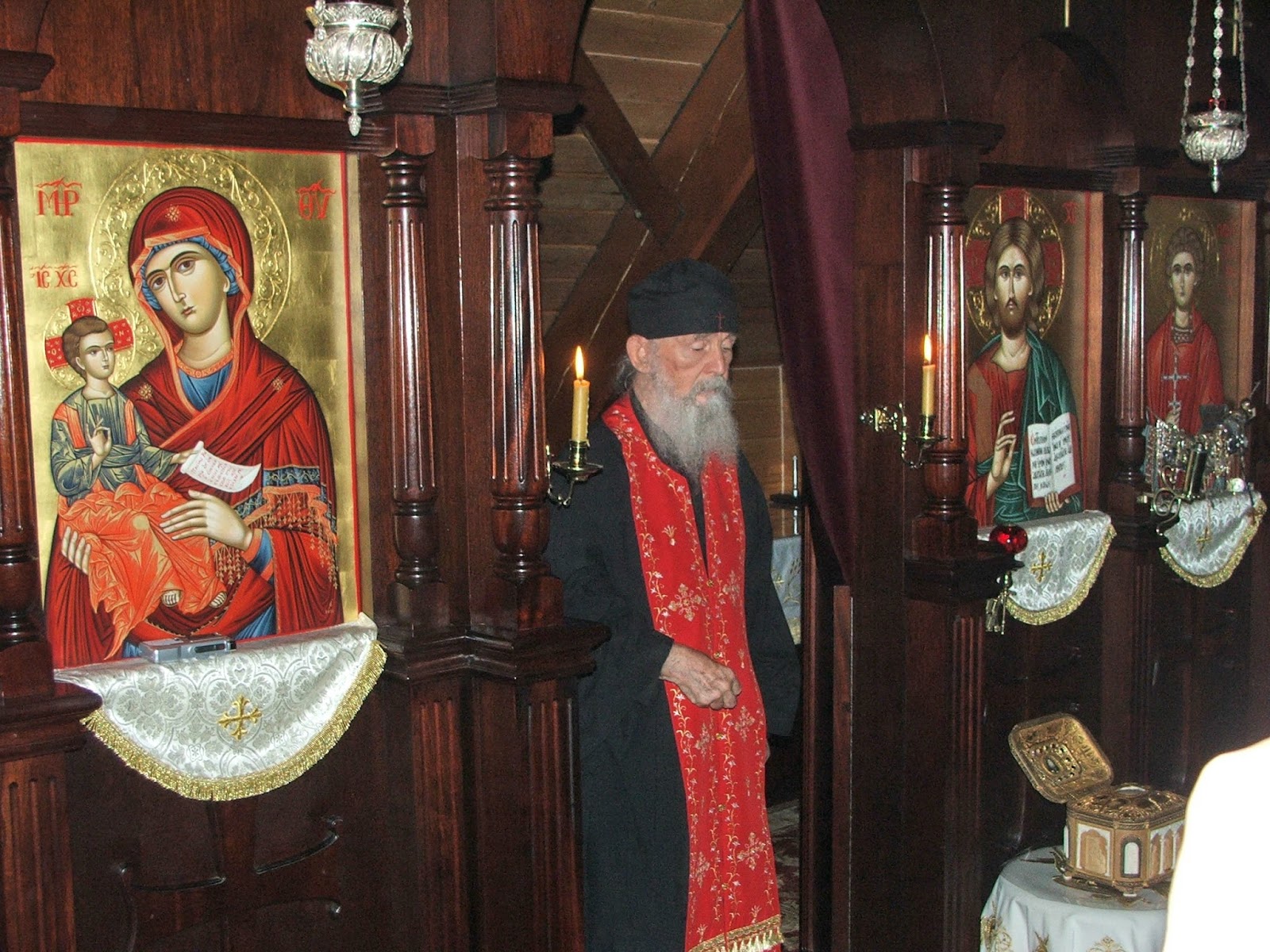
Trusting in God's Providence, by Archimandrite Ephraim of Arizona
Archimandrite Ephraim of St Anthony's, Florence AZ
"You say that your brother was hungry, thirsty, and so on when he was sick, and he blasphemed. You also said that your brother was committing a mortal sin.
God, though, Who is very compassionate, wanted to bring him to a realization of his guilt so that he would repent, so He gave him this illness out of paternal love as a spiritual medication to cure his soul of its illness.
"You say that your brother was hungry, thirsty, and so on when he was sick, and he blasphemed. You also said that your brother was committing a mortal sin.
God, though, Who is very compassionate, wanted to bring him to a realization of his guilt so that he would repent, so He gave him this illness out of paternal love as a spiritual medication to cure his soul of its illness.
If you had looked after your brother and offered him every bodily comfort, what pains would he have suffered for God to see and have pity on him? You should realize that the more he was tormented, the more his penalty was lightened!
God gave him the illness and allowed the brethren to neglect their duty towards him so that his conscience would make him feel remorse and repent. He is like a patient who is given medicine by a doctor, but lacks the necessary patience. Thus, he curses and grumbles at the doctor, which only leads to his own demise."
Elder Ephraim of Arizona
Source
Source
Sunday, October 11, 2015
The Cross in the Christian Life by Abbott Ephraim of Vatopaidi
Abbot Ephraim of Vatopaidi Monastery in Mount Athos, Greece preaches a homily on the Cross in the Christian Life. This video is in Greek with English subtitles.
Saturday, May 2, 2015
The Fruit of Humility
Icon in the Church of Panagia Dexia
Thessaloniki, Greece
"Abba John the Short asked the monks: "Who sold Joseph?" One monk replied: "His brothers." To that, the elder replied: "No brethren, rather his humility. Joseph could have said that he is their brother and could have protested to being sold but he remained silent. His humility, therefore, sold him. Afterward, this same humility made him master over Egypt."
In surrendering ourselves to the will of God, we defend ourselves too much from external unpleasantness, that is why we lose the good fruits which is harvested at the end of unpleasantness endured with humility.
Abba Pimen wisely spoke: "We have abandoned the easy yoke, i.e., self-reproach and we have burdened ourselves with a heavy yoke, i.e., self-justification."
The Christian accepts every unpleasantness as deserving of their present or their past sins; seeking in all, the will of God with faith and awaiting the end with hope."Reading from the Prologue of Ochrid for May 3rd by St Nikolai Velimirovich
Thursday, September 25, 2014
"I Have Many Sorrows of my Own" by St Silouan the Athonite
St Silouan the Athonite
“The Merciful Lord loves His own servants and gives them sorrows on earth, so that the soul would through sorrows learn humility and dedication to God’s will and find peace in the pain, as the Lord said: Learn from Me, for I am meek and lowly of heart, and you will find rest unto your souls.” This is what St. Silouan of Mt. Athos wrote in one of his letters—and he was a saint who truly knew by his own experience the color of pain."
To read this article in full, please visit Pravoslavie.ru/english
“The Merciful Lord loves His own servants and gives them sorrows on earth, so that the soul would through sorrows learn humility and dedication to God’s will and find peace in the pain, as the Lord said: Learn from Me, for I am meek and lowly of heart, and you will find rest unto your souls.” This is what St. Silouan of Mt. Athos wrote in one of his letters—and he was a saint who truly knew by his own experience the color of pain."
To read this article in full, please visit Pravoslavie.ru/english
Wednesday, April 3, 2013
Hidden Joy by Igumen Nektary (Morozov)
Archimandrite Sophrony Sakharov
Fragment from an article posted in the Orthodox blog
"Somewhere I happened to read a line written by Archimandrite
Sophrony (Sakharov), “Grace comes to the heart that has
It seems it was in a letter to Hieromonk Dimitry (Balfour)… And a
line by the Apostle Paul was something I didn’t come across by
chance—I have read it many times, over and over: For just as we
share abundantly in the sufferings of Christ, so also our comfort
abounds through Christ (2 Cor. 1:5)…So, on Saturday at the Vigil
Service, during the Polyeleos I was looking at the icon of St. Gregory
Palamas and thought about his amazing life, about the light of
Mt. Tabor, the nature of which he so wisely explained and in which
he himself abided—being transformed, illumined, “reaching for the
heights”. What grace he lived in! But then it was as if a spear pierced
my heart: How he also suffered!
And not only he, but anyone who with time had become no longer a
slave but a friend of God, one of those who pleased Him, and became
like unto Him insofar as that is possible for a human being. No
matter whom we talk about—martyrs and passion-bearers, holy
hierarchs and monastic saints, about righteous women and fools-
for-Christ they all had to suffer. Only they had all different kinds of
sufferings—some were physical, others emotional, caused by ill-
intentioned people, or sometimes from the demons, hateful and
inhuman.
But no one, absolutely no one, as St. Isaac the Syrian said, “has ever
ascended to heaven by living coldly.” And from what we have come
to know and are still learning, he also testifies that a person is
especially looked after by God when the Lord sends him constant
sorrows. Abba Isaac also adds that there is no other path to draw
closer to Christ other than the path of sorrows."
Fragment from an article posted in the Orthodox blog
"Somewhere I happened to read a line written by Archimandrite
Sophrony (Sakharov), “Grace comes to the heart that has
suffered.”
It seems it was in a letter to Hieromonk Dimitry (Balfour)… And a
line by the Apostle Paul was something I didn’t come across by
chance—I have read it many times, over and over: For just as we
share abundantly in the sufferings of Christ, so also our comfort
abounds through Christ (2 Cor. 1:5)…So, on Saturday at the Vigil
Service, during the Polyeleos I was looking at the icon of St. Gregory
Palamas and thought about his amazing life, about the light of
Mt. Tabor, the nature of which he so wisely explained and in which
he himself abided—being transformed, illumined, “reaching for the
heights”. What grace he lived in! But then it was as if a spear pierced
my heart: How he also suffered!
And not only he, but anyone who with time had become no longer a
slave but a friend of God, one of those who pleased Him, and became
like unto Him insofar as that is possible for a human being. No
matter whom we talk about—martyrs and passion-bearers, holy
hierarchs and monastic saints, about righteous women and fools-
for-Christ they all had to suffer. Only they had all different kinds of
sufferings—some were physical, others emotional, caused by ill-
intentioned people, or sometimes from the demons, hateful and
inhuman.
But no one, absolutely no one, as St. Isaac the Syrian said, “has ever
ascended to heaven by living coldly.” And from what we have come
to know and are still learning, he also testifies that a person is
especially looked after by God when the Lord sends him constant
sorrows. Abba Isaac also adds that there is no other path to draw
closer to Christ other than the path of sorrows."
Please continue reading here.
Saturday, October 29, 2011
Pain of Heart according to Fr Seraphim Rose
This book is available from St Herman Press
In my search for those things that can help me in my purpose to
achieve the purification of my heart, I pay particular attention to
those words, writings and personal encounters in which I come
face to face with real Orthodox spiritual experience. It is very hard
to describe it. The gift of spiritual discernment is given to those
advanced in the spiritual life but, at a more humble level, there is
something to be said about the simplicity of a soul that intuitively
recognizes the still small voice of her Creator, our Lord Jesus
Christ, in the humble disguise of our fellow human beings who
know Him, and in the providential circumstances of our lives.
to describe it. The gift of spiritual discernment is given to those
advanced in the spiritual life but, at a more humble level, there is
something to be said about the simplicity of a soul that intuitively
recognizes the still small voice of her Creator, our Lord Jesus
Christ, in the humble disguise of our fellow human beings who
know Him, and in the providential circumstances of our lives.
Fr Seraphim Rose knew very well how to recognize this small
voice and the state of a heart that is perceptive and open to
divine grace. He calls it 'pain of heart'. His disciple Fr
Damascene, describes this spiritual state in page 471 of the
book 'Father Seraphim Rose His Life and Works',
"Pain of Heart. In this is found the last and most crucial key to
divine grace. He calls it 'pain of heart'. His disciple Fr
Damascene, describes this spiritual state in page 471 of the
book 'Father Seraphim Rose His Life and Works',
"Pain of Heart. In this is found the last and most crucial key to
Fr. Seraphim's entry into the mind of the Fathers.In the Patristic
writings, 'pain of heart' generally refers to an elemental
inward suffering , the bearing of an interior cross while
following Jesus Christ, and a spirit broken in contrition.
inward suffering , the bearing of an interior cross while
following Jesus Christ, and a spirit broken in contrition.
'Suffering', Father Seraphim stated, 'is the reality of the human
condition and the beginning of true spiritual life'. From Archbishop
John (of San Francisco), who had utterly crucified himself in this life,
Fr Seraphim had learned how to endure this suffering in thankfulness
to God, and from him he had learned its fruits. If used in the right way,
suffering can purify the heart and 'the pure in heart shall see God'
(Matthew 5:8). 'The right approach' wrote Fr. Seraphim ' is found
in a heart which tries to humble itself and simply knows that it
is suffering, and that there somehow exists a higher truth which
can not only help this suffering, but can bring it into a totally
different dimension.'
According to St Mark the Ascetic (fifth century), 'Remembrance of God
is pain of heart endured in the spirit of devotion. But he who forgets
God becomes self indulgent and insensitive'. And in the words of
St Barsanuphius the Great of Egypt, whose counsels Fr. Seraphim
translated into English, 'Every gift is received through pain of heart'.
Fr Seraphim had learned how to endure this suffering in thankfulness
to God, and from him he had learned its fruits. If used in the right way,
suffering can purify the heart and 'the pure in heart shall see God'
(Matthew 5:8). 'The right approach' wrote Fr. Seraphim ' is found
in a heart which tries to humble itself and simply knows that it
is suffering, and that there somehow exists a higher truth which
can not only help this suffering, but can bring it into a totally
different dimension.'
According to St Mark the Ascetic (fifth century), 'Remembrance of God
is pain of heart endured in the spirit of devotion. But he who forgets
God becomes self indulgent and insensitive'. And in the words of
St Barsanuphius the Great of Egypt, whose counsels Fr. Seraphim
translated into English, 'Every gift is received through pain of heart'.
Besides its general meaning, 'pain of heart' has a liturgical meaning
in the writings of the church Fathers, for when the heart is
concentrated in fervent prayer to Christ, it may be actually
pained. As Fr. Seraphim noted, in Patristic terminology the
'heart' does not mean mere 'feeling', but 'something much
deeper - the organ that knows God'. The heart is both spiritual
and physical: spirituality is the center of man's being, identified
with his nous (spirit); physically, it is the organ where the nous
finds its secret dwelling place. Concentrated within the spiritual
heart, the nous cries out to the Savior, and such a heart-cry
born in pain and desperation, yet hoping in God - calls down
Divine grace.
This is seen especially in the Orthodox practice of the Jesus Prayer.
(Note: The Jesus Prayer reads, 'Lord Jesus Christ, Son of God, have
mercy on me, the sinner'. It is very common to use an abbreviated form
such as, 'Lord Jesus Christ, have mercy on me'). When we approach
the Jesus Prayer simply, says Elder Paisios of Mount Athos (+1994),
'we will be able to repeat it many times, and our heart will feel a sweet
consolation inside our heart'.
'The Patristic teaching on pain of heart', Fr Seraphim wrote, 'is one
of the most important teachings for our days when head-knowledge is
so over-emphasized at the expense of the proper development of
emotional and spiritual life. The lack of this essential experience is
what above all is responsible for the dilettantism (superficiality, lack
of discipline), the triviality, the want of seriousness in the ordinary
study of the Holy Fathers today; without it, one cannot apply the
teachings of the Holy Fathers to one's own life....without pain of heart,
one can be a barren fig tree, a boring 'know it all' who is always
correct...(one) who does not know and cannot convey the true spirit of
the Holy Fathers."
From Fr Seraphim Rose - His Life and Works p. 471-472, by Hieromonk Damascene,
St Herman Press 2003
in the writings of the church Fathers, for when the heart is
concentrated in fervent prayer to Christ, it may be actually
pained. As Fr. Seraphim noted, in Patristic terminology the
'heart' does not mean mere 'feeling', but 'something much
deeper - the organ that knows God'. The heart is both spiritual
and physical: spirituality is the center of man's being, identified
with his nous (spirit); physically, it is the organ where the nous
finds its secret dwelling place. Concentrated within the spiritual
heart, the nous cries out to the Savior, and such a heart-cry
born in pain and desperation, yet hoping in God - calls down
Divine grace.
This is seen especially in the Orthodox practice of the Jesus Prayer.
(Note: The Jesus Prayer reads, 'Lord Jesus Christ, Son of God, have
mercy on me, the sinner'. It is very common to use an abbreviated form
such as, 'Lord Jesus Christ, have mercy on me'). When we approach
the Jesus Prayer simply, says Elder Paisios of Mount Athos (+1994),
'we will be able to repeat it many times, and our heart will feel a sweet
consolation inside our heart'.
'The Patristic teaching on pain of heart', Fr Seraphim wrote, 'is one
of the most important teachings for our days when head-knowledge is
so over-emphasized at the expense of the proper development of
emotional and spiritual life. The lack of this essential experience is
what above all is responsible for the dilettantism (superficiality, lack
of discipline), the triviality, the want of seriousness in the ordinary
study of the Holy Fathers today; without it, one cannot apply the
teachings of the Holy Fathers to one's own life....without pain of heart,
one can be a barren fig tree, a boring 'know it all' who is always
correct...(one) who does not know and cannot convey the true spirit of
the Holy Fathers."
From Fr Seraphim Rose - His Life and Works p. 471-472, by Hieromonk Damascene,
St Herman Press 2003
Sunday, January 30, 2011
The Cup of Christ by St. Ignatius Brianchaninov
Two beloved disciples asked the Lord for thrones of glory, and He gave them His Cup (Matthew 20.23).
The Cup of Christ is suffering. But for those who drink from it on earth, the Cup of Christ grants participation in Christ's Kingdom. It prepares for them the thrones of eternal glory in heaven. We stand in silence before the Cupof Christ, nor can any man complain about it or reject it; for He, Who commanded us to taste it, first drank of it Himself.
O tree of knowledge of good and evil! You killed our ancestors in Paradise, you deceived them by the delusions of sensual pleasure and the delusions of reason. Christ, the Redeemer of the fallen, brought His Cup of Salvation into this world — to the fallen and to those who are exiled from Paradise.
The bitterness of this Cup cleanses the heart from forbidden, destructive and sinful pleasure. Through the humility that flows from it in abundance, the pride of understanding on the carnal level is mortified. To him who drinks from the Cup with faith and patience, the eternal life, which was — and still is — lost to him by his tasting of forbidden fruit, will be restored.
I will accept the Cup of Christ — the cup of salvation.
The Cup is accepted when the Christian bears earthly tribulation in the spirit of humility learnt from the Gospel. St Peter turned swiftly with a naked sword to defend the God-Man, Who was surrounded by evil doers; but Jesus said to Peter: Put up thy sword into the sheath: the cup which My Father hath given Me, shall I not drink it? (John 18.11).
So, too, when disaster surrounds you, you should comfort and strengthen your soul, saying, 'The Cup which my Father hath given me, shall I not drink it?' The Cup is bitter: at first sight all human reasoning is confounded. Surmount reason by faith and drink courageously from the bitter Cup: it is the Father Who gives it to you, He who is all good and all wise. It is neither the Pharisees, nor Caiaphas, nor Judas who prepared the Cup; it is neither Pilate nor his soldiers who give it! The cup which my Father hath given me, shall I not drink it?
Pharisees think evil, Judas betrays, Pilate orders the unlawful killing, the soldiers of the government execute his order. Through their evil deeds all these prepared their own true perdition. Do not prepare for yourself just such a perdition by remembering evil, by longing for and dreaming of revenge, and by indignation against your enemies. The heavenly Father is almighty and all-seeing. He sees your affliction, and if He had found it necessary and profitable to withdraw the Cup from you, He would certainly have done so.
The Lord, as the Scriptures and Church history testify, has often allowed afflictions to befall His beloved, and often warded off afflictions from them, in accordance with the unfathomable ways of Providence. When you are faced with the Cup, turn your gaze from the people who gave it to you; lift up your eyes to Heaven and say: 'The Cupwhich my Father hath given me, shall I not drink it?'
I will take the cup of salvation... (Psalm 115.4 [LXX]); I cannot reject the Cup — the promise of heavenly and eternal good. The Apostle of Christ teaches me patience when he says, we must through much tribulation enter into the Kingdom of God (Acts 14.22). How can we reject the Cup, which is the means of attaining this Kingdom and growing with it? I will accept the Cup — the gift of God. For the Cup of Christ is the gift of God. The great Paul writes to the Philippians, For unto you is given in behalf of Christ, not only to believe on Him, but also to suffer for His sake (Philippians 1.29).
You receive the Cup, which seemingly comes from the hand of man. What is it to you whether the bearer of the Cup acts righteously or unrighteously? As a follower of Jesus, your concern is: to act righteously; to receive the Cup with thanksgiving to God and with a living faith; and courageously to drink it to the dregs.
In receiving the Cup from the hand of man, remember it is the Cup of Him, Who is not only innocent but All-Holy. Thinking on this, remind yourself, and other suffering sinners, of the words that the blessed and enlightened thief spoke when he was crucified on the right hand of the crucified God-Man: We receive the due reward of our deeds ... Lord, remember me when Thou comest into Thy kingdom (Luke 23.41-42). And then, turning to the people, you will say to them: Blessed are you who are instruments of righteousness and of God's mercy, blessed are you from henceforth and for ever! (If they are not in a fit state to understand and receive your words, do not cast your precious pearls of humility under the feet of those who cannot value them, but say these words in thought and heart.) By this alone will you fulfill the commandment of the Gospel which says, Love your enemies, bless them that curse you (Matthew 5.44).
Pray to the Lord on behalf of those who have insulted and outraged you that what they have done for you should be repaid by a temporal blessing and the eternal reward of salvation, and that, when they stand before Christ to be judged, it should be counted to them as if it had been an act of virtue. Although your heart does not wish to act in this way, compel it to do so, because only those who do violence to their own heart, in fulfilling the commandments of the Gospel, can inherit Heaven.
If you have not the will to act in this way, then you have not the will to be a follower of the Lord Jesus Christ. Look deep within yourself and consider searchingly: have you not found another teacher, the teacher of hatred — the devil — and fallen under his power?
It is a terrible transgression to offend or to oppress one's neighbour: it is a most terrible transgression to commit murder. But whoever hates his oppressor, his slanderer, his betrayer, his murderer, and whoever thinks ill of them and takes revenge on them, commits a sin very near to their sin. In vain does he pretend to himself and others that he is righteous. Everyone who hates his brother is a murderer of man, proclaimed St John, the beloved disciple of Christ (cf. 1 John 3.15).
A living faith in Christ teaches one to receive the Cup of Christ, and the Cup of Christ inspires hope in the heart of him who receives it; and hope in Christ gives strength and consolation to the heart. What torment, what torment of hell, to complain or to murmur against the Cup that is pre-ordained from above! Murmuring, impatience, faintheartedness and especially despair are sins before God — they are the ugly children of sinful disbelief.
It is sinful to complain of neighbours, when they are the instruments of our suffering; still more sinful is it when we cry out against the Cup that comes down to us straight from Heaven, from the right hand of God.
But he who drinks the cup with thanksgiving to God and blessings on his neighbour achieves holy serenity — the grace of the peace of Christ. It is as if already he enjoys God's spiritual Paradise.
Temporal suffering has no importance in itself: we lend it significance because of our attachment to the earth and to all corruptible things, and through our coldness towards Christ and eternity. You are prepared to bear the bitter and repellent taste of medicines; to bear the painful amputation and cauterization of your limbs; to bear the long, drawn-out suffering of hunger and prolonged seclusion in your room. You are prepared to bear all this to restore lost health to your body, which after it is healed will certainly become ill again, and will certainly die and become corrupt. Bear, then, the bitterness of the Cup of Christ, which brings healing and eternal beatitude to your immortal soul.
If the Cup appears to you to be unbearable, deadly, then it reveals that although you bear Christ's name, you do not yet belong to Christ. For the true followers of Christ, the Cup of Christ is the Cup of joy. Thus, the holy apostles, after having been beaten before the gathering of the elders of the Jews, went out from the presence of the council rejoicing that they were counted worthy to suffer shame for the Name of the Lord Jesus (cf. Acts 5.40-41).
Righteous Job heard bitter news. Tiding after tiding came to pierce his steadfast heart; the last of these was the hardest: all his sons and daughters had been struck down suddenly by a cruel and violent death. In his great sorrow, he rent his clothes and covered his head with ashes. And then, in submissive faith, he fell down upon the ground and worshipped the Lord saying, 'I myself came naked from my mother's womb, and naked shall I return thither: the Lord gave, the Lord has taken away: as it seemed good to the Lord, so has it come to pass; blessed be the name of the Lord.'
Source - Monachos.net
Subscribe to:
Posts (Atom)
Recommended Reading
- A Commentary On The Divine Liturgy by St. Nicholas Cabasilas, ISBN: 0-913836-37-0
- A Night in the Desert of the Holy Mountain by Metropolitan Hierotheos Vlachos Trans. by Effie Mavromichali, ISBN: 960-7070-31-3
- A Spiritual Psalter or Reflections On God excerpted by St. Theophan the Recluse from the works of St. Ephraim the Syrian, Trans. by Antonina Janda, ISBN 0-912927-40-2
- Against False Union ( with a prologue by Photios Kontoglou) by Alexander Kalomiros, Trans. by George Gabriel, ISBN: 0-913026-49-2
- Akathist To Jesus Conqueror of Death, by St Nikolai Velimirovich, Trans. by Interklima, Copyright 2009, English Edition, by St Paisius Monastery, Safford, AZ
- An Athonite Gerontikon by Archimandrite Ioannikios, Holy Monastery of St Gregory Palamas Kouphalia, Greece 1991
- Byzantine Theology by John Meyendorff, ISBN: 0-8232-0967-9
- Christ Our Way and Our Life by Archimandrite Zacharias Zacharou, ISBN 1-878997-74-2
- Christ The Eternal Tao by Hieromonk Damascene, ISBN 0-938635-85-9
- Commentary on The Gospel of St Luke by St Cyril of Alexandria Trans. by R.Payne Smith, Studion Publishers, Inc. ISBN:0-943670-01-2
- Concerning Frequent Communion by Nikodemos the Hagiorite, Trans. by George Dokos, ISBN: 960-86778-5-8
- Confronting Controlling Thoughts by Antony M. Coniaris, ISBN: ISBN: 1-880971-88-7
- Conversations with Children by Sister Magdalen, ISBN: 1-874679-21-5
- Counsels from the Holy Mountain by Elder Ephraim of Philotheou, ISBN: 0-9667000-2-3
- Daily Readings with St. Isaac of Syria, Trans. by Sebastian Brock, ISBM: 0-87243-173-8
- Dance, O Isaiah by Constantine Platis, unknown printing 2000
- Diary Of A Pilgrimage from the Ancient Christian Writers series, by Egeria, Trans. by George E. Gingras, ISBN: 0-8091-0029-0
- Drinking from the Hidden Fountain by Thomas Spidlik, ISBN: 0-87907-348-9
- Elder Ephraim of Katounakia Trans by Tessy Vassiliaou-Christodoulou, ISBN: 960-7407-33-4
- Elder Paisios of Mount Athos Spiritual Counsels, Spiritual Awakening vol 2, Trans by Fr. Peter Chamberas, Holy Monastery 'Evangelist John The Theologian' Souroti, Greece 2007
- Elder Paisios of Mount Athos Spiritual Counsels, With Pain And Love for Contemporay Man vol1, Trans by Cornelia A. Tsakiridou & Maria Spanou, Holy Monastery 'Evangelist John The Theologian' Souroti, Greece 2006
- Epistles by Elder Paisios of Mount Athos, Holy Monastery of the Evangelist John the Theologian, Souroti, Greece 2002
- Father Arseny Trans. by Vera Bouteneff, ISBN 0-88141-180-9
- Flame in the Snow, A Life of St Seraphim of Sarov by Julia de Beausobre, ISBN: 0-87243-223-8
- From St. Isaac The Syrian to Dostoyevsky by Archimandrite Vasileios, Trans. by Dr.Elizabeth Theokritoff, ISBN: 1-896800-34-3
- Grace For Grace: The Psalter And The Holy FathersCompiled and Edited by Johanna Manley, ISBN: 0-9622536-1-8
- Hesychia and Theology by Metropolitan Hierotheos Vlachos, Trans. by Sister Pelagia Selfe, ISBN: 978-960-7070-60-9
- His Life is Mine by Archimandrite Sophrony, ISBN: 0-913836-33-8
- I Love Therefore I Am by Fr. Nicholas V. Sakharov, ISBN: 0-88141-236-8
- In The Light of Christ, St Symeon The New Theologian by Archbishop Basil Krivocheine Trans. by Anthony P. Gythiel, ISBN 0-913836-91-5
- Isaac of Ninaveh ( Isaac The Syrian) The Second Part, chapters IV-XLV, Trans. by Sebastian Brock, ISBN: 90-6831-709-1
- Missionary Lettersof Saint Nikolai Velimirovich vol 1, Trans. by Hierodeacon Serafim, New Gracanica Monastery, Grayslake, IL
- Monastic Wisdom, The Letters of Elder Joseph The Hesychast, ISBN: 0-9667000-0-7
- Mount Athos Renewal in Paradise by Graham Speake, ISBN: 0-300-093535
- Nil SorskyTrans. and Edited by George A. Maloney, ISBN: 0-8091-9810-7
- Not of This World,Compiled and Edited by James S. Cutsinger, ISBN: 0-941532-41-0
- On Prayer by Archimandrite Sophrony Sakharov Trans.by Rosemar Edmonds, ISBN 0-88141-194-9
- On The Apostolic Preaching by St. Irenaeus of Lyons, Trans. by John Behr, ISBN: 0-88141-174-4
- On The Cosmic Mystery of Jesus Christ by St Maximus The Confessor, Trans. by Paul M. Blowers & Robert Louis Wilken, ISBN: 0-88141-249-x
- On The Human Condition by St Basil The GreatTrans. by Nonna Verna Harrison, ISBN: 0-88141-294-5
- On The Incarnation by St. Athanasius, ISBN: 0-913836-40-0
- On The Mother of God by Jacob of Serug, ISBN: 0-88141-184-1
- Once Delivered to The Saints by Fr. Michael Azkoul, ISBN: 0-913026-84-0
- Orthodox Faith and Life in Christ by Father Justin Popovich Trans. by Asterios Gerosterios, ISBN: 1-884729-02-9
- Orthodox Psychotherapy by Metropolitan Hierotheos Vlachos, Trans. by Esther Williams, ISBN: 960-7070-27-5
- Orthodox Spiritual Life According to Saint Silouan The Athonite by Harry Boosalis, ISBN: 1-878997-60-2
- Orthodox Spirituality and The Philokalia by Placide Deseille Trans. by Anthon P. Gythiel, ISBN 978-0-9717483-7-8
- Orthodox Spirituality by Metropolitan Hierotheos Vlachos, ISBN 960-7070-20-8
- Passions and Virtues According to Saint Gregory Palamas by Anestis Keselopulos, ISBN: 1-878997-75-0
- Patristic Theology by John S. Romanides, ISBN 978-960-86778-8-3
- Prayers by the Lake by St Nikolai Velimirovich, The Serbian Orthodox Metropolinate of New Gracanica, Grayslake, IL 1999
- Saint Cyril of Alexandria and the Christological Controversy by John McGuckin, ISBN: 0-88141-259-7
- Santa Biblia Antigua Version de Casiodoro De Reina Revisada por Cipriano de Valera(1602) Revision de 1960, Holman Publishers 2008
- St John of Damascus, The Fathers of the Church series, Trans. by Frederic H. Chase, Jr., ISBN: 0-8132-0968-4
- St Seraphim of Sarov, A Spiritual Biography by Archimandrite Lazarus Moore, ISBN: 1-880364-13-1
- St Silouan The Athonite by Archimandrite Sophrony, ISBN 0-88141-195-7
- St. Symeon The New Theologian, On The Mystical Life, The Ethical Discourses, Trans. by Alexander Golitzin 3 vols. ISBN: 0-88141-142-6 and - 143-4, and 144-2
- Standing In God's Holy Fire by John A. McGuckin, ISBN: 1-57075-382-2
- Symeon The New Theologian, The Discourses, Classics of Western Spirituality, ISBN: 0-8091-2230-8
- Symeon The New Theologian, The Practical and Theological Discourses and The Three Theological Chapters, Trans. by Dr. Paul McGuckin, Cistercian Publications Inc. 1982
- The Acquisition of The Holy Spirit by I.M. Kontzevitch, ISBN: 0-938635-73-5
- The Adam Complex by Dee Pennock, ISBN: 1-880971-89-5
- The Ascetical Homilies of Saint Isaac The Syrian, Trans. by Holy Transfiguration Monastery, ISBN: 0-913026-55-7
- The Authentic Seal by Archimandrite Aimilianos, ISBN: 960-85603-3-0
- The Book of Mystical Chapters, Trans. and introduced by John A. McGuckin, ISBN: 1-59030-007-6
- The Boundless Garden by Alexandros Papadiamantis Edited by Lambros Kamperidis and Denise Harvey, ISBN 978-960-7120-23-6
- The Church Fathers ( Ante-Nicene, Nicene and Post-Nicene Fathers, published by Hendrickson Publishers, Peabody Massachusetts, 37 vol. set
- The Enlargement of The Heart by Archimandrite Zacharias Zacharou, ISBN 0-9774983-2-8
- The Faith of Chosen People by St Nikolai Velimirovich, The Free Serbian Diocese of America and Canada, Grayslake, IL 1988
- The Faith of The Saints , A Catechism by St. Nikolai Velimirovich, ISBN:1-932965-06-8
- The Fifty Spiritual Homilies, Pseudo-Macarius, ISBN: 0-8091-0455-5
- The Gurus, the Young Man, and Elder Paisios by Dionysios Farasiotis, ISBN: 978-1-887904-16-2
- The Heart by Archimandrite Spyridon Logothetis, ISBN 960-86639-4-6
- The Hidden Man of The Heart by Archimandrite Zacharias Zacharou, ISBN 978-0-9800207-1-7
- The Holy Bible NKJV, Thomas Nelson, 1992
- The Homilies of Saint Gregory Palamas by Christopher Veniamin, 2 vols. ISBN: 1-878997-67-X; ISBN: 1-878997-68-X
- The Ladder of Divine Ascent by St. John Climacus Edited by Holy Transfifuration Monastery 1979, ISBN 0-943405-03-3
- The Life of St. Anthony by St. Athanasius the Great, Eastern Orthodox Books, Willits, CA
- The Lives of The Holy Prophets by Holy Apostles Convent, ISBN: 0944359-12-4
- The Living Witness of the Holy Mountain by Hieromonk Alexander Golitzin, ISBN: 1-878997-48-3
- The Luminus Eye by Sebastian Brock, ISBN: 0-87907-524-4
- The Mind of the Orthodox Church by Metropolitan Hierotheos Vlachos, Trans. by Esther Williams, ISBN: 960-7070-39-9
- The One Thing Needful by Archbishop Andrei of Novo- Diveevo, ISBN: 91-2927-29-1
- The Orthodox Ethos, Studies in Orthodoxy Edited by A.J. Philippou, Hollywell Press Oxford 1964
- The Orthodox New Testament 2 vols., Published by The Holy Apostles Convent 1999, ISBN: 0-944359-17-5 & 0-944359-14-0
- The Philokalia, The Complete Text compiled by St Nicodemos of the Holy Mountain and St Makarios of Corinth, Trans. by G.E.H. Palmer, Phillip Sherrard and Kallistos Ware Vol 4 ISBN: 0-571-11727-9
- The Philokalia, The Complete Text compiled by St Nicodemos of the Holy Mountain and St Makarios of Corinth, Trans. by G.E.H. Palmer, Phillip Sherrard and Kallistos Ware Vol2 ISBN: 0-571-15466-2
- The Philokalia, The Complete Text compiled by St Nicodemos of the Holy Mountain and St Makarios of Corinth, Trans. by G.E.H. Palmer, Phillip Sherrard and Kallistos WareVol 3 ISBN: 0-571-17525-2
- The Philokalia, The Complete Textcompiled by St Nicodemos of the Holy Mountain and St Makarios of Corinth, Trans. by G.E.H. Palmer, Phillip Sherrard and Kallistos Ware, Vol 1 ISBN: 0-571-13013-5
- The Philokalia: Master Reference Guide Compiled by Basileios S. Stapakis, Trans by G.E.H. Palmer, Phillip Sherrard, Kallistos Ware, ISBN: 1-880971-87-9
- The Prologue of Ohrid, Trans. by Fr. Timothy Tepsic, vol 1 ISBN: 978-0-9719505-0-4; vol 2 ISBN: 978-0-9719505-1-1
- The Psalter Trans. by Holy Transfiguration Monastery, ISBN: 0-943405-00-9
- The Spiritual World of St Isaac the Syrian by Bishop Hilarion Alfeyev, Cistercian Publications, Kalamazoo, Michigan 2000
- The Way of A Pilgrim trans.by R.M. French, ISBN 345-24254-8-150
- We Shall See Him As He Is by Archimandrite Sophrony Sakharov, ISBN 0-9512786-4-9
- Wisdom. Let Us Attend: Job, The Fathers, and The Old Testament by Johanna Manley, ISBN: 0-9622536-4-2
- Words of Life by Archimandrite Sophrony, Trans. by Sister Magdalen, ISBN1-874679-11-8
- Writings from The Philokalia On Prayer of The Heart, Trans. by E. Kadloubovsky and G.E.H. Palmer, ISBN: 0-571-16393-9


.jpg)